The Tragedy of JBP

Jordan B. Peterson, darling of the right, punching bag of the left, has had an amazingly shitty year.

Peterson rocketed to fame after publishing a couple of books and making some fairly anodyne (as far as I can tell) statements about the encroachment of political correctness on college campuses and in Canadian Law.

Fame is bad for people: just look at the lives of movie stars. At this point, Hollywood has probably developed some protocols for dealing with some of the unpleasant parts of being famous–I doubt Johnny Depp reads all of the mail he receives; Lady Gaga probably has someone who manages her online presence, etc–but we know Peterson wasn’t doing this because his daughter is doing his press releases.

Authors don’t expect to become famous, much less reviled.

I should note that I haven’t actually read Peterson’s book (I’m not in the market for self-help), nor have a watched more than a smattering of podcasts/interviews, but I have spent enough time here on the internet to get the general flavor of things. Peterson has always struck me as a basically kind-hearted, well-intentioned person who was trying to help others, not tear them down, so even if I disagreed with this or that specific thing he said, he still seemed like a pretty decent guy.

In exchange for being basically decent and trying to help people, Peterson received an amazing amount of hate. The left reacted to him like a demon casting off its disguise and screaming in hysterical rage.

Most famous people get more love than hate; this level of hate isn’t good for anyone, much less someone who isn’t a sociopath or a murderer.

Despite the hysterics that JBP was going to destroy civilization, he has faded pretty quickly from view. His time in the spotlight ended with a speed that makes all of the hysteria look, in retrospect, absurd. He wasn’t a threat; he was just a guy who published a book and had his fifteen minutes of fame.

The benefit of hindsight makes the lunacy of it all the stranger. I can’t think of a similarly mid-profile leftist (Peterson is way below the fame level of Krugman or Ta Nehisi) who has received the same level of vitriol. Maybe David Hogg? (But maybe that’s just sampling bias due to the particular things I happen to read.)

Peterson faded from view in part because there isn’t very much for intellectual “right wingers” who aren’t insane and aren’t on TV to do. Books take a long time to write, and hosting a regular podcast gets old. The idea that JBP was part of the “Alt Right” was only ever correct in the vaguest sense of him not being part of the mainstream Republican right, which I wouldn’t really expect him to be since he’s not even an American. He doesn’t seem to be racist, think we should repeal the 19th amendment, or want to invade Poland. The idea that he is some sort of gateway to the Alt Right proper is the kind of fevered nonsense that comes of trying to smash all human existence into a single left-right axis with everything that is not explicitly trying to accelerate leftward labeled as “reactionary.”

But anyway, Peterson’s life since he dropped out of sight has apparently been absolutely awful. According to his daughter, “Dad was put on a low dose of a benzodiazepine a few years ago for anxiety following an extremely severe autoimmune reaction to food.”

This is maddeningly specific and unspecific at the same time. What sort of autoimmune reaction? What sort of food? Is he allergic to shellfish? I am familiar with some of the conditions that might get characterized this way, eg:

In a joint effort,  Ye Qian, PhD, professor of dermatology, and Timothy Moran, MD, PhD, assistant professor of pediatrics, found that walnut allergen, in addition to inducing allergic diseases to certain individuals, could also promote autoantibody development in an autoimmune skin disease called pemphigus vulgaris. …

Two major outcomes of a dysfunctional immune system are allergy and autoimmunity. Growing evidence suggests there are some connections between the development of these two abnormalities.

Can autoimmune conditions cause anxiety? Presumably they can cause all sorts of things, especially if we play fast and lose with what we call “autoimmune.” People who are breaking out in hives and feel their throats constricting because they just ate a peanut presumably feel a lot of anxiety. Some people who are sensitive to wheat experience psychiatric symptoms (eg, celiac psychosis) that are caused by some sort of weird bodily reaction to the wheat.

So this is not a crazy thing to claim, but it might be garbled since some people use terms like “autoimmune” very loosely.

BUT, if the anxiety was caused by an autoimmune reaction to food, then the correct response shouldn’t have been psychiatric medication. It should have been treating the autoimmune disorder (and eliminating whatever food was triggering it from the diet). For that you probably need immune-suppressing drugs like infliximab or steroids like prednisone.

Anxiety is unpleasant and benzos can bring it down, especially in an emergency, but if the autoimmune condition is triggering the anxiety than you really aren’t making it go away. This is life if you have the flu and it’s causing a fever and you take an aspirin to bring down your fever, well, you still have the flu and you still feel shitty.

Except instead of aspirin, you’re taking something that is much stronger and has a much higher risk of side effects.

So at least from what she’s said (and I admit that this might be a highly compressed or slightly garbled account of things,) Peterson shouldn’t have been on benzos at all and had a different medical disorder that effectively went untreated.

According to his daughter, Peterson’s dose was increased when his wife developed cancer. Cancer is understandably extremely stressful and people need help getting through it, though I question the wisdom of giving psychiatric medication for people going through conditions which really ought to make you feel shitty. If your wife is dying and you don’t feel bad, I think there’s something wrong.

At this point, the bezos stopped doing their job (perhaps because of the untreated autoimmune disorder?):

It became apparent that he was suffering from both a physical dependency and a paradoxical reaction to the medication.

This is really interesting, at least from an abstract point of view.

To radically over-simplify the brain, think of it as having two potential directions, up and down. When you up regulate something, you get more of it. When you downregulate, you get less of it. The actual mechanics involved are obviously way more complicated. Sometimes a chemical has an exciting effect, so more of that chemical means more of the effect you want, and sometimes a chemical has a depressing effect, so more of that chemical means less of the effect you want. Brains also have receptors, which have to be present to actually use the chemicals, so it doesn’t matter how many chemicals you have if you don’t have any receptors to receive them.

Anti-anxiety drugs, like alcohol, are designed to depress the brain. Here’s a great video by ChubbyEmu explaining how alcohol dependence works:

I don’t know the exact mechanism of benzos, but the principle is likely the same. As you put in more and more depressants, trying to down-regulate the brain, the brain up-regulates something else to reassert homeostasis. This is how you build up tolerance to drugs and even become dependent on them: the physical architecture of your brain has been modified to deal with them. Take the drugs away, and suddenly the physical architecture of the brain no longer has the the right balance of chemicals to receptors that it needs. If you take out a depressant, suddenly your brain is massively up-reulated. If you’ve been chugging alcohol, all of that un-depressed brain activity is likely to massively up itself into a seizure as brain activity explodes.

In Peterson’s case, when he tried to go off benzos, he developed akathisia, a condition usually described as restlessness but described by people who’ve had it as an absolutely maddening compulsion to move endlessly for hours and hours and hours on end with no rest or stillness, no ability to turn off the racing thoughts in your brain or stop talking like you are a train hurling 300 miles an hour down the track until you fall asleep, exhausted, only to wake up the next day and do it all over again until you want to put a bullet in your brain.

I am pretty sure that you can recover from this as your brain eventually resets to its original balance, but that takes a very long time and in the meanwhile you are still dependent on the same drug/medication that caused the problem in the first place. (A hospital dealing with a patient going through acute alcohol withdrawal will give the patient alcohol to stop their seizure, for example.)

Here is where it seems that Mikhaila and her dad gave up on “North American” medicine and went off to Russia to detox Peterson cold turkey.

After several failed treatment attempts in North American hospitals, including attempts at tapering and micro-tapering, we had to seek an emergency medical benzodiazepine detox, which we were only able to find in Russia.

I understand where they’re coming from and their frustration, but once you’ve built a tolerance to drug, there is no safe way to detox without tapering, and tapering is just going to be shitty, because your brain is now designed to use that drug and you can’t get around that until you build new brain architecture.

Unfortunately, just as going cold turkey off an alcohol addition can cause seizures, so taking Peterson off the benzos seems to have had terrible effects, and he ended up in a COMA. Excuse me, a medically induced coma. I think they usually do that because someone has gone into uncontrollable seizures, but maybe there are other reasons for them:

She and her husband took him to Moscow last month, where he was diagnosed with pneumonia and put into an induced coma for eight days. She said his withdrawal was “horrific,” worse than anything she had ever heard about. She said Russian doctors are not influenced by pharmaceutical companies to treat the side-effects of one drug with more drugs, and that they “have the guts to medically detox someone from benzodiazepines.”

There is just so much horrifying here; Peterson, please do not ever place your life in your daughter’s hands again. She does not understand addiction. Look, I undrserstand your reluctance to try to treat the akasithia with more medications, but that is not a good reason to go to Russia. Peterson could just have refused the prescription for anti-akasithia drugs while still continuing a controlled, tapered detox in a “North American” hospital. The fact that they apparently couldn’t find any doctors in all of “North America” who would sign off on this plan, not even a “naturopath”, is a huge red flag. Of course his withdrawal was “horrific”; that’s why the doctors kept telling you not to do this fucking thing but you had to go drag your dad to some second world country to find doctors willing to gamble with his life.

By the way, a “coma” shouldn’t be “horrific.” By nature, people in comas don’t really do anything. They’re asleep. Something is being left out of this story.

She continues:

Jordan Peterson has only just come out of an intensive care unit, Mikhaila said. He has neurological damage, and a long way to go to full recovery. He is taking anti-seizure medication and cannot type or walk unaided, but is “on the mend” and his sense of humour has returned.

Aha. Seizures. Looks like I was right. The “horrific” part of this ordeal was most likely her dad going status epilepticus. But let’s all admire the “guts” of Russian doctors to go along with this absolutely insane idea and give her dad permanent brain damage. Great job, Mikhaila.

Everything about this is horrifying. Peterson strikes me as a decent man who wanted to make people’s lives better. Whether his advice was good or not, most of it didn’t sound outright terrible. Hard to go wrong with “clean your room.” He’s been hit with a ton of hate, his wife had cancer, and he was, from the sounds of it, incorrectly put on very strong and dependency forming medications. Getting off the medication became its own hell, so his daughter gave up on “North American” medicine and went for the cold turkey method, which of course caused seizures and brain damage.

Bloody hell.

I know where people are coming from when they look at conventional medicine and say, “Gosh, that seems wrong.” Yes, putting Peterson on benzos on the first place may have been wrong. Increasing his dosage may have also been wrong. There may have been other wrong decisions in there. But that doesn’t make going off cold turkey the right decision.

There’s this awful place you end up when you have a medical condition that falls just on the edge of mapped medical territory. We are great at treating broken bones. Trauma medical care is amazing. We can transplant organs and save people from heart attacks. Antibiotics and vaccines are also amazing. And we have solved many long-term conditions, like type 1 diabetes.

Autoimmune conditions are much harder to treat and much less well-mapped territory. Sometimes doctors are wrong. Sometimes ordinary people have good ideas that medicine hasn’t recognized yet. Sometimes a specialized diet like eating just meat is exactly what someone needs. And sometimes it isn’t. Sometimes the doctors are right. Finding the correct balance and knowing which information to trust (some peer-reviewed medical papers have turned out to be fraudulent, too,) can be hard. I don’t know how to resolve this dilemma besides “Start with accepted medicine. Talk to doctors. Watch Chubby Emu or something similar. Get a basic idea of the land. Then move on to patient forums. See what patients say. Sometimes patients report side effects as being much more common or severe than medical studies indicate. Sometimes they indicate that certain medications are more effective than indicated. etc. Watch out for anyone touting a cure that sounds too good to be true or that could kill you (do NOT, under any circumstances, drink a gallon of soy sauce.) Watch out for rabbit holes where the relevant authors only cite each other. Watch out for “papers” that don’t seem to have come from anywhere. Watch out for people trying to sell you something. And just keep learning as much as you can.”

Good luck, try to stay healthy and well. Get your sunshine.

I hope poor Peterson recovers.

Eugenics!

Everyone is talking about eugenics, so I thought I’d dive into the mix.

The first difficulty in discussing eugenics lies in the fact that different people use the word to mean different things. It does no good to use one sense of the term when replying to someone who meant something completely different, so we’re going to have to start with a range of definitions:

  1. Selective breeding to positively influence the distribution of traits in the gene pool
  2. Anything that positively influences the distribution of traits in the gene pool
  3. Purposefully removing specific negative traits from the population
  4. Anything undertaken to increase desirable traits in the population
  5. Valuing one human life over another
  6. Killing off “undesirable” people
  7. Genocide
  8. etc.

Although the dictionary definition is closer to number 1 or 2, most of the time when people use the word “eugenics”, they mean it in the sense of something coercive and unpleasant. When someone decides that they would rather marry and have children with someone they find attractive than someone they find unattractive, they don’t regard themselves as practicing “eugenics,” though they are making a decision about which traits they are passing on to the next generation.

Even aside from disagreements over definitions, people become emotional about eugenics. Many people are incredibly bad at separating moral and factual statements. Much of the opposition to Dawkin’s suggestion that eugenics works is not actually about whether it works so much as moral outrage over the idea of harming innocent people. They hear “eugenics,” and their brains jump to “gas chambers.” In contrast, when people hear of ways to improve traits that don’t involve harming specific people, they tend not to call it “eugenics.”

For example, suppose we found a vitamin that could reliably make people smarter, so the government decided to use tax dollars (personal sacrifice) to provide vitamins to everyone, even the poor. Most people would think this was fine because it’s a net positive.

Yes, this example doesn’t involve genetics, but it would change the distribution of traits in the population and it would make everyone smarter. It’s also something we already do: we put iodine in the salt, vitamin D in the milk, etc.

Now suppose we could use magic CRISPR bots to remove a person’s propensity to develop Alzheimer’s, fix heart disease, decrease their chance of cancer, etc. Maybe the CRISPR bots are delivered in pill form. If these pills fixed problems like trisomy 21, genetic mental retardation, genetic vision and hearing loss*, etc., most people suffering from these conditions would freely chose to take the pills and would consider them a miracle. If they couldn’t afford them, I think most people would support using tax dollars to fund these treatments in the same way that we pay for normal medical care. Access to CRISPR bots to correct severe genetic defects would soon be considered a basic human right.

These treatments would be true eugenics, but likely wouldn’t be controversial because they wouldn’t directly harm anyone (at least until athletes started using them in the same way they currently use steroids).

By contrast, people would object strongly to something like a government board that gets veto power over who you get to marry–or that decrees whom you must marry. This would be a significant personal sacrifice with a very nebulous promise of social benefit. This is the sort of thing people are actually objecting to. 

*There is some pushback against mechanical (surgical, etc) attempts to fix certain disabilities. Some people in the deaf community, for example, do not think there is anything “wrong” with them and have complained that giving people implants to fix deafness is “genocide” against their community. While this does nothing to the genetics of the population, they clearly feel like it falls under the general category of trying to get rid of deaf people, at least as a culture. This objection is fairly rare, however.

The question of whether “eugenics works” depends on both how you define eugenics and “works”. Certainly if I had supervillain-like powers and an island full of captive humans, I could selectively breed them to be taller, shorter, prettier (by my standards,) etc. Could I breed for personality? Absolutely. We’ve bred for golden retrievers, after all. I wouldn’t be able to breed for anything I wanted: X ray vision probably isn’t possible.

But we live in the real world, where I don’t have god-like superpowers. In the real world, it’d be governments doing the eugenics, and I have some serious doubts about the abilities of real-world governments in this regard.

The Germans are trying, though:

Closing EU borders will lead to inbreeding, German finance minister warns:

In an interview with weekly paper Die Zeit, Mr Schäuble rejected the idea Europe could close its borders to immigrants, and said: “Isolation is what would ruin us – it would lead us into inbreeding.”

Taking aim at opponents of Germany’s border policies, he said: “Muslims are an enrichment of our openness and our diversity.”

Global Warming Poll

I noticed a while back that many of the people who fit roughly into the “global warming skeptic” category don’t disagree entirely with the idea, so I wanted to investigate more deeply. Here are the preliminary results of my poll:

If you don’t believe in Global Warming, why?

A. I do believe, but I don’t admit it because I think libs are trying to use GW for political ends I disagree with
B. I believe, but I want the Earth to get warmer because winter sucks
C. I believe, but I don’t think it’s going to be a big deal/there’s nothing I can do about it
D. I stopped paying attention to environmentalists sometime around 1995 because their predictions always fail to come true
E. People who claim to believe in global warming don’t actually act like they believe it, so I don’t, either
F. I don’t find the science/evidence I’ve seen convincing
G. The Earth is too big for humans to have an effect
H. Something else I will explain in the comments

Thanks to everyone who participated. Many people went into detail about their opinions rather than pick any of the given options, which was great because it helped me see flaws in the poll and get a deeper insight into what people are thinking. In retrospect, C should have been broken into two options and there should have been another option similar to A but is “I don’t believe it because I think libs are just using it to push a political agenda.”

That said, here are the rough results after smooshing people’s responses into the closest categories:

A. Disagree w/ politics: 27
B. Winter sucks: 14
C. No big deal/can’t change: 32
D. Lost credibility: 10
E. Don’t act like they believe it: 11
F. Science: 17
G: Earth too big: 3

Other:
H. Cult: 7
I. Real but not caused by humans: 3
J. It’s real: 4

Qualitatively, rather than quantitatively, I think results broke down into three main categories: 1. disagreement with libs about politics/solutions, 2. personal credibility of the global warming advocates, 3. science.

Under disagreements, many people noted that global warming gets used to advocate almost solely for leftist causes like socialism, while other important solutions are ignored, eg, @CamperWatcher27′s take:

It’s a true scientifically proven crisis, the solution for which just happens to be implementation of every left wing wishlist item. It mandates no policy sacrifice by the left whatsoever, it’s almost too good to be true.

A couple of people noted that often the solutions, like shipping plastic trash to China so it can be burned under the guise of “recycling”, do more harm than good, and many people noted that there is effectively nothing they can do about China’s pollution, eg @laikasrefectory’s opinion:

I do, and I find the evidence convincing, but find fault in where fingers are pointed, and agree that the topic is weaponised. The West could stop all emissions tomorrow and we’d still be fucked thanks to China and India.

Many readers complained that environmentalists aren’t in favor of building more nuclear power plants, limiting immigration, or virtually any other “right wing” position that would also help the environment.

Personal credibility of environmentalists turned out to be more important than I expected. People didn’t just object that global warming advocates don’t actually act like they believe in global warming (I just finished talking to a relative who is both concerned about global warming wiping Florida off the map and preparing to fly around the world for an international vacation), but they also objected on the grounds that global warming is a “cult” or “religion.” (This was a little annoying from the coding perspective because it doesn’t answer the question–believing that Christianity is a religion doesn’t stop Christians from believing in it.) I interpreted these responses, therefore, as “this is a belief system that those people hold an I don’t happen to hold it,” just as I might respond if suddenly put on the spot and asked why I don’t believe in shamanism.

There were also people who remembered fears of “global cooling” in the 70s or had grown weary of the media habit of attributing practically everything bad that happens to “climate change,” even when there’s no way to prove it causally. A good example from @punishedkomrade:

The exaggerated predictions of doom, combined with the unseriousness of “solutions” (eg We need socialism to save the Climate! Ew, not nuclear!) leads me to ignore the issue

Then there’s the science:

This is quite remarkable. You might think that more intelligent people would hold more similar opinions, since we all have access to the same scientific material (more or less). Instead, dumb people take more moderate stances while intelligent people throw themselves toward their tribe’s extreme.

For example, here is @billkristolmeth‘s take on the science:

Explain how a ~400ppm (0.04%) trace gas acts as a “control knob” on global temperature. Explain why CO2 has a greater effect than water vapor.
Explain why models that do not factor in cloud albedo can be considered reliable in long-term prediction of climate.
Explain why solar output is considered generally irrelevant by the model makers despite being measurably variable.
Explain why substantially higher CO2 in the past on Earth did not cause Earth to become a Venus-like hothouse as predicted by some models.
These are the sorts of questions that I eventually started asking as the time to DOOM compressed. Sure the climate changes, it always has. The CO2 hypothesis however is based almost entirely on vastly incomplete models and I find it unconvincing on a basic thermodynamics level.

I believe in global warming (specifically, I believe the claims of climate scientists that the Earth is getting warmer and it is caused by humans), but I can’t answer these questions. I believe because scientists I know in real life respect other scientists who think global warming is real. By contrast, none of the astronomers I know in real life have ever mentioned the sun causing global warming. This is a chain of trust (or authority), not first-hand knowledge and understanding of climate data. I suspect something similar is going on for other people–which science they find credible is determined by which scientists they find credible.

This chain of trust is interesting, because it relates back to different groups of people being, essentially, separate. There are other cases where different groups have different chains of trust–obviously Israelis and Palestinians believe different news sources about the region. There are black communities on the internet that also have their own “science” with its own separate chain of trust, usually centering around claims that melanin has fantastic powers and that white people kidnap black children to harvest their melanin (I think this claim was motivated by confusion about the difference between melanin and melatonin, which you can buy at the store). Native Americans also distrust mainstream science (especially genetics) and don’t include it in their chain of authority, though they don’t tend to replace it with anything in particular.

If you happen not to find any scientists credible (or you just aren’t into science), then your next fallback is judging the kinds of people who advocate for global warming (well, advocate for doing something about it,) and their policy solutions. If the upshot of global warming advocacy in your real life is an “energy and water efficient” clothes washer that has to be run twice for every load of laundry because it doesn’t use enough water to get the soap off, you’re going to be pretty darn skeptical of this whole deal.

Obviously my poll isn’t terribly scientific or accurate, but I think it’s close enough to capture the zeitgeist. So if anyone reading this actually wants to save the planet, then I think the first thing you (and others) should do is disentangle global warming and politics. Don’t make global warming a reason to vote left–this is making the survival of our planet dependent on irrelevant questions like “Do you like gays?” Come up with ideas that appeal to people from both sides of the political aisle, like using nuclear power to achieve energy independence. Second, you need to act like you actually believe it. Stop flying. Stop buying products made in China and shipped across the ocean in great big carbon-belching container ships. Ride your bike to work. Then, maybe, people will take you seriously.


Fighting the Bureaucracy

Modern civilization is plagued by many evils, but the most common, in everyday life, is paperwork. By “paperwork” I mean basically all bureaucratic overhead, all of the accounting, regulation and compliance enacted in the past century.

Paperwork is the devil.

David Graeber gets it: 

… as early as the 1970s, formerly leftist parties from the US to Japan made a strategic decision to effectively abandon what remained of their older, working-class base and rebrand themselves primarily as parties representing the interests and sensibilities of the professional-managerial classes. This was the real social base of Clintonism in the US, Blairism in the UK, and now Macronism in France. All became the parties of administrators. …

Whereas the core value of the caring classes is, precisely, care, the core value of the professional-managerials might best be described as proceduralism. The rules and regulations, flow charts, quality reviews, audits and PowerPoints that form the main substance of their working life inevitably color their view of politics or even morality. These are people who tend to genuinely believe in the rules. They may well be the only significant stratum of the population who do so. If it is possible to generalize about class sensibilities, one might say that members of this class see society less as a web of human relationships, of love, hate, or enthusiasm, than, precisely, as a set of rules and institutional procedures, just as they see democracy, and rule of law, as effectively the same thing. …

For most care-givers, however, these people are the enemy. If you are a nurse, for example, you are keenly aware that it’s the administrators upstairs who are your real, immediate class antagonist. The professional-managerials are the ones who are not only soaking up all the money for their inflated salaries, but hire useless flunkies who then justify their existence by creating endless reams of administrative paperwork whose primary effect is to make it more difficult to actually provide care.

I call these people “lizards” because they do not seem to have human souls.

Some amount of paperwork, of course, is necessary to keep track of things in a modern, industrial economy in which food for 320 million people has to get from farms to tables every single day. The expansion of paperwork beyond its necessary domain is essentially the auto-cannibalization of society, a metastatic cancer of bureaucrats and paper-pushers.

If we want to fight bureaucracy, we have to know what feeds bureaucracy.

Bureaucracy grows because people don’t trust each other to do the right thing. It grows because people over-graze the commons, because they dump toxic waste into rivers, because they build cheap apartments that turn into flaming death traps, because they take bribes and cover up incompetence, because they discriminate against minorities or hand out sinecures to their friends.

The demands for paperwork are generally demands that you prove that you have or can do the right thing–that you will not pollute, that you have car insurance, that your products are not dangerous or defective, that your medicines aren’t poisons and your experiments don’t involve giving people syphilis.

The more people do not trust each other to do the right thing, the more layers of bureaucracy they institute. If I am afraid that police officers are taking bribes, then I propose more oversight and agencies to ensure that they do not take bribes. If I am concerned that mining companies are paying off the EPA to let them dump toxic metals in the groundwater, then my response is to demand another agency come and clean out the EPA and enforce tougher restrictions on dumping. If I don’t trust you, then I hire someone to watch you.

The problem with this approach is that adding more untrustworthy people to a system doesn’t start making them trustworthy. If I can bribe one person, then I can bribe the person who is supposed to make sure that no one gets bribed. In the end, we just end up with more people to bribe.

And that’s if you’re lucky. If you’re unlucky, people are “ethical” and the whole thing grinds to a halt. To get your new building built you first need authorization from the wetlands licensing committee, and the lady from the licensing committee wants thirteen forms in triplicate proving that your building won’t impact the mating habits of a rare toad that you are pretty sure doesn’t even live in your state. To get your study on the efficacy of a survey your clinic already hands out to patients approved by the ethics board of your local institution you first have to prove that you will not be collecting personal data from at-risk patients, but you can’t know if they are “at risk” until after you collect their data. Or maybe the guy who is supposed to send you the form you have to fill out simply isn’t returning your phone calls and you can’t figure out from the website where his office is located.

The more you try to fight bureaucracy with more bureaucracy, the more bureaucracy wins, and the bureaucracy does not care if you starve to death, you Kulak.

To the bureaucracy, you are always a Kulak.

There are two ways to break a bureaucracy. One, total system collapse. This happened to the Soviet Union. It takes a long time, it’s not fun, and you can starve to death in the meanwhile. The replacement system may not be much better.

The other is to increase trust so that people don’t advocate for more bureaucracy in the first place. True, this doesn’t get rid of what you’ve got, but at least it contains the spread.

Trust is hard to get, though. You could do a thousand year breeding experiment. You could try to brainwash children. Or you could look at how the incentives are set up in your society and try to align them with the outcomes you want to achieve. (We can try, at least.)

Aligning incentives requires doing something hard: admitting that humans are human. Communism keeps failing because of “wreckers,” aka ordinary humans. Humans will lie, cheat, and steal if it benefits themselves; this is why we have police. Humans will also fall in love, have sex, and make children. We will then cheat and steal to feed our children, if need be, because we love them.

Accept human nature and align incentives accordingly. (Easier said than done, of course.)

Here is an entertaining example:

For simplicity’s sake, I’ll quote the rest:

The mafia backed company actually had good, fresh food! Most of the mobsters’ kids went to those schools (several I went to school with saw their dads go down). The sandwiches were real hoagies on good bread, there was fresh fruit, juice, etc. All local.

Then, overnight, all their food was gone, and their vending machines too. And they were replaced by the corporate equivalent. And we were excited too! National brands, etc! Now the good stuff! Nope.

The corporate food was shite. No more local, fresh ingredients. The portions were smaller. All the food was overly processed and overpriced. It was just nasty. I remember my dad and others laughing bitterly about it.

At the time, I was struck by how these unintended consequences were the most visceral ones. Later in life, I came to realize that this was the norm: that the unintended consequences of any major political change are often the ones with the greatest impact.

But it was also my first inkling that the real world differences between the literal mafia, and the even greater power of modern corporations, were not as black and white, or clear cut, as those who benefitted from the latter would have any of us believe. Fin/

I knew and dreaded Aramark as a kid. When people, whether kids or prisoners, don’t have a choice about the food they eat, the quality tends to suffer. By contrast, when you are feeding your own children (or the children of mobsters), cooking quality tends to be decent.

The same dynamic as at work in children’s electronics. Electronics that are marketed solely to kids, like the LeapFrog system, tend to be bad (often very bad) because the buyer (parents) tends not to be the users (kids), and kids often don’t have enough experience with electronics to realize they’re being ripped off. (Every augmented reality devices I have bought has been similarly bad to awful.) The only good kids’ electronics systems I have encountered also have significant adult fanbases, like Nintendo.

Capitalism, of course, is the classic case of aligned incentives. Invisible hand and all that. It’s not perfect (corporations will eat you for breakfast if they can get away with it,) but it’s pretty good. People are more likely to protect the commons when they have an expectation of future gain from the commons.

Reputation also helps align incentives. People care about what others think of them. The internet has both expanded our ability to interact with total strangers who have no reputations and to create reputations, with interesting effects. Sites like Amazon and Yelp allow small, previously unknown sellers to build up their reputations, making people more confident about what they’re buying.

By contrast, the recent kerflufle over Youtube, trying to make it more kid-friendly via increased regulation, has done nothing of the sort. None of the things parents want to protect kids from have actually been addressed because bureaucracy just doesn’t work that way, but if you don’t like Youtube, you already have the very easy option of using literally any other content service.

Incentives matter.

The Best of Egyptian art?

egypt
Typical Egyptian painting

If you’ve ever spent a few minutes looking at Egyptian art, you’ve probably noticed something odd: their human figures are remarkably stiff. In paintings and relief carvings, all of the figures strike the same awkward pose: shoulders toward the viewer, hips forward. Here is a typical example:

Statue after statue stands rigidly still, hands at its sides, feet together. (Some sit rigidly.) Walk into the Greek gallery next door and the contrast is remarkable. Greek statues don’t sit, they sprawl. They don’t just stand, they lean. They run. They saunter. They struggle. Greek statues feel alive.

coat450
Typical Greek painting of a woman

The ancient Egyptians were not bad artists. This ring decorated with tiny horse statues is exquisite. The faces on their best statues rival the Greeks, and they outshine the Greeks in rendering women, whom the Greeks oddly could not draw. Paintings of Greek men look like actual humans; paintings of Greek women, however, are stylized–here is an example, because otherwise you won’t believe me. Take a good look at her face. Note the way her forehead descends directly to the tip of her nose in a straight line, without curving as it passes the eyes, nor out along the nose. It would be quite disconcerting if you saw such a profile on a real person; to make it work, they would need a pointed forehead that juts out considerably and “curves” into the skull in a box-like straight edge beneath their hair. 

(By contrast, Greek men were sometimes allowed a normal nasal bridge.)

Their renderings of non-human subjects, like scarabs and hippos, are also excellent. All in all, the Egyptians were clearly skilled artists who for some reason did not draw human movement.

One theory I have seen is that the Egyptians simply did not know how to draw humans in different poses. They could look at people, they could copy various details about people, like their faces and clothes, but they couldn’t come up with the mental idea of drawing a figure that didn’t have its shoulders facing the audience.

This is essentially the ratchet theory of culture. It proposes that talent is common, but true innovators are rare. Once an innovation occurs, however, it enters the cultural lexicon and talented people can copy it.

2016_ancient_egyptian_art_07.447.505_sl1_2000w_600_807
Terra cotta figurine, predynastic period, about 3500 BC through 3400 BC. From the Brooklyn Museum

But this theory depends on the assumption that the Egyptians couldn’t do any better. What if their style was a choice?

So I went looking for ancient Egyptian art that didn’t fit the mold, pieces that aren’t stereotypically Egyptian, and I found them pretty quickly. Take this statuette from the Brooklyn Museum. Their website states:

Based on images painted on jars of the same date, the female figure with upraised arms appears to be celebrating a ritual. The bird-like face probably represents her nose, the source of the breath of life. The dark patch on her head represents hair, also a human trait. Her white skirt indicates a high-status individual.

Now, this is a very primitive piece, and very old. The sculptor did not bother with fiddly details like “a face”. But it clearly expresses movement, and it is not an isolated piece–as the museum notes, similar figures were painted on jars at the time. Clearly the Egyptians of circa 3,450 BC understood “movement” and could express it in art.

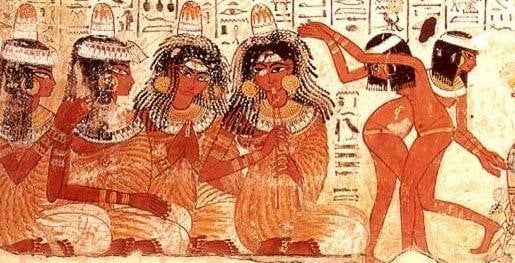
Here is a painting of two Egyptian dancing girls (and flute players). Given the technical limitations of paint and surfaces, they are as well drawn as a great many Greek works.

97b24804a0ccb9b075fd8e2a0ec68f4e21e732eb
Battle scene from King Tut’s tomb

Here is one of my favorite Egyptian pieces, a battle scene from King Tut’s tomb.

Yes, the figures are mostly placed in the typical Egyptian posture, shoulders toward us, hips away, but their usual stasis is gone. The painting is a riot; people are everywhere.

Here is a much older depiction of the aftermath of an Egyptian battle, showing a lion and carrion birds feasting on corpses:

It is obviously a more primitive piece, carved before Egyptian style had been completely standardized. But we still see that the figures are allowed to lie every which way; some are in the typical pose, but others, like the captives at the top, are not.

In general, Egyptian art is more expressive when the figures involved have lower social status. Pharaohs are grandiose statues with chiseled pecs, staring quietly into the middle distance; captured slaves are allowed to look around.

One of my favorite pieces I found during this search is this statuette of a boy (warning, nudity.) It is not actually exceptional, but it made me laugh. Children were often depicted without clothes in Egyptian art, and he’s not flipping us off (my first reaction), but putting a finger to his lips in a “childlike” pose. This stele of Ramasses II as a child also features the finer to the lips pose; here is another child with his finger to his lips, in the statue of Nykara and his family.

800px-la_salle_dakhenaton_281356-1340_av_j.c.29_28musc3a9e_du_caire29_28207697208629
Akhenaten and Aten, the sun

We do have some records of what the Egyptians thought of their art. Akhenaten, a pharaoh of the 18th dynasty who died around 1335 BC introduced a radical suite of reforms, including an attempt to convert Egypt to monotheism and demands that his artists sculpt his potbelly and scrawny arms rather than make him super buff. He was also depicted in more natural settings than other pharaohs, like this carving of the royal family playing with their children. (Though the artist seems to have never seen a child.)

This artistic shift produced a few statues that are so strange looking that they have inspired theories that he was part alien. I think it more likely that he was an ordinary guy who didn’t exercise and ate too much, maybe with a bit of inbreeding in his family tree. (I don’t know about his parents, but Akhenaten himself married his half-sister, Nefertiti.) I find speculation that he had Marfan’s syndrome more credible than the alien hypothesis.

After Akhenaten’s death, not only were his reforms rolled back, but many of his statues were defaced and subsequent rulers basically tried to make everyone forget about him.

At any rate, Akehnaten’s demand that artists change their style to depict him more realistically gives it away: artists were depicting their subjects unnaturally on purpose. Clearly at least some ancient Egyptian artists could depict people in realistic poses, but they chose not to develop this style because it didn’t fit with the (usual) purpose of their art. Most pharaohs did not want their statues to be realistic; they wanted them to command the fear and awe of the masses.

If someone were judging the quality of American artists based on portraits of our presidents, they would also note an absence of naturalistic posing or movement. They’re all standing or sitting, even that rather unusual one with Obama. Few of our monuments–take the Lincoln Memorial–feature dynamic sculptures.

Formal portraits tend to be quite static, and the Egyptians made a lot of formal portraits.

And since the Egyptians generally didn’t bother making realistic looking portraits, they didn’t develop the talent.

144833
From the MFA

Once the Greeks and Romans show up, Egyptian art changes quite a bit. Take this mummy mask of a young woman, from about 100-130 AD. The Greek influence is particularly noticeable in her hairstyle and in the side view, available on the MFA website, which reveals the sharp, Greek-style edge where her forehead ought to curve smoothly into her skull.

This statue from the same era also looks very Greek-inspired.

Of course, the fact that the Egyptians could pick up an art style once they were exposed to it doesn’t tell us whether they could have developed it on their own. Perhaps they could have, with a few more rulers like Akhenaten, brave (or brazen) enough to break the mold, or if art had become a more mass-market phenomenon.


Call for Bullshit Submissions

I have long wanted to construct a general bullshit detection system that helps people detect bad or spurious arguments, and for that I need some good examples of bullshit (and non-bullshit).

Making a specific bullshit detector is easy: just learn about the subject. For example, if you say that you’ve carbon dated some dinosaur bones, then I automatically know you’re lying because carbon dating only works for things that are younger than about 50,000 years, and dinosaur bones are at least 65 million years old. (Also, dinosaur bones don’t contain a lot of carbon.)

But knowing more about the subject than the person you are talking to doesn’t generalize–for practical reasons, it is impossible for everyone to know everything.

So what’s a bullshit argument that you’ve encounter related to a field that you know but I don’t? For example, I know very little about chemistry, how the electrical grid works, or the Belorussian national anthem. I don’t know what temperature melts steel beams nor medieval Chinese history.

Each example of bullshit needs to be paired with a comparable piece of non-bullshit from the same field, otherwise I’ll automatically know it’s bullshit. Don’t tell me which is which.

Links, memes, Facebook posts, blog posts, youtube videos, “try googling this,” etc, are all fine. The arguments should be framed and phrased the way their proponents actually make them, because phrasing and formatting might be important.

I would love to assemble a really vast data set, and super appreciate anything and everything you send.

Pygmy and Philistine DNA

Good news: a kind reader has pointed me to the full text of the Ancient West African Foragers paper, which I am reading now:

All of the mtDNA and Y chromosome haplogroups we observe at Shum Laka are associated today with sub-Saharan Africans. The two earlier individuals carry mtDNA haplogroup L0a (specifically L0a2a1), which is widespread in Africa, and the two later individuals carry L1c (specifically L1c2a1b), which is found among both farmers and hunter-gatherers in Central and West Africa. Individuals 2/SE I and 4/A have Y chromosomes from macrohaplogroup B (often found today in hunter-gatherers from Central Africa17), and 2/SE II has the rare Y chromosome haplogroup A00, which was discovered in 2013 and is present at appreciable frequencies only in Cameroon—in particular, among the Mbo and Bangwa in the western part of the country. A00 is the oldest known branch of the modern human Y chromosome tree, with a split time of about 300,000–200,000 bp from all other known lineages.

At 1,666 positions… that differ between present-day A0018 and all other Y chromosomes, the sequence of the Shum Laka individual carries the nonreference allele at a total of 1,521, translating to a within-A00 split at about 37,000–25,000 bp. 

As noted last week, there’s a lot of genetic diversity in Aka/Baka pygmies back around 20,000 years ago.

In other news, National Geographic has an interesting article on a Biblical enemy.

Who were the Philistines?

Modern archaeologists agree that the Philistines were different from their neighbors: Their arrival on the eastern shores of the Mediterranean in the early 12th century B.C. is marked by pottery with close parallels to the ancient Greek world, the use of an Aegean—instead of a Semitic—script, and the consumption of pork.

The “sea peoples” were a bunch of invaders who, like the Vikings, showed up suddenly in the coastal Mediterranean in the midst of the Bronze Age Collapse (indeed, they triggered much of it.)

The four early Iron Age DNA samples, all from infants buried beneath the floors of Philistine houses, include proportionally more “additional European ancestry” in their genetic signatures (roughly 14%) than in the pre-Philistine Bronze Age samples (2% to 9%), according to the researchers. While the origins of this additional “European ancestry” are not conclusive, the most plausible models point to Greece, Crete, Sardinia, and the Iberian peninsula.

Why were Philistines burying babies underneath their houses? (Answer: to keep the family together. Apparently a common practice to save the bones of your dearly departed.)

Interestingly, the “European” component in these burials is a blip-in-time, but the culture remained long after. When we put together the DNA, archaeology, and various written records from the various Mediterranean cultures, we can piece together a pretty coherent picture.

I remember reading back in highschool–I still have the book; it’s in the other room–about how the Trojan War was a real event, but that the ancient Greek narratives described a conflict that was actually geographically much bigger than what Homer described. During the Greek dark age caused by the Bronze Age Collapse, there were many oral poets and many stories composed about the deeds of the late heroes, and the ones that have made it down to represent only a small selection of these. Of the ones we have, people tend only to read the most famous and complete, but even here we can find differences in the narrative account between, say, Homer and the tragedians, who were all working from the same base material of popular oral poetry.

In one of the lesser-known accounts, the Greeks, having lost Helen to Paris, go through all of the effort of rounding up all of the heroes, making all of the requisite sacrifices to he gods, etc, set sail, and burn down some city in Egypt. They return home and realize, oopsies, we burned the wrong city and have to go do it all over again, this time at Troy.

Another story holds that Helen herself was never in Troy, but spent the war hanging out in peace and prosperity in Egypt while the Trojans themselves suffered.

Troy being, as far as I know, a rather small and unimportant city by the standards of the day, I have thus long believed that the “real” Trojan war was a conflict between Greek tribes and the Egyptians, who had a civilization worth looting, and that they happened to burn/loot a lot of other small towns along the way. We hear about Troy and not Egypt because the Greeks conquered Troy and got their butts kicked in Egypt, and no one likes to sing about their losses.

This whole business of the Greeks going a-Viking collapsed the local Mediterranean economy, but of course there was a lot of other stuff going on at the same time, too. Bronze Age Collapse can’t just be blamed on the Greeks. Not only were there non-Greek invaders in other places, there were also a bunch of crop failures, droughts, etc. The effects were big:

The palace economy of the Aegean region and Anatolia that characterised the Late Bronze Age disintegrated, transforming into the small isolated village cultures of the Greek Dark Ages. The half-century between c. 1200 and 1150 BC saw the cultural collapse of the Mycenaean kingdoms, of the Kassite dynasty of Babylonia, of the Hittite Empire in Anatolia and the Levant, and of the Egyptian Empire;[1] the destruction of Ugarit and the Amorite states in the Levant, the fragmentation of the Luwian states of western Asia Minor, and a period of chaos in Canaan.[2] The deterioration of these governments interrupted trade routes and severely reduced literacy in much of the known world.[3] In the first phase of this period, almost every city between Pylos and Gaza was violently destroyed, and many abandoned, including HattusaMycenae, and Ugarit.[4]

Interestingly, though, the pull-back of some of the bigger empires at the time, like the Egyptians, may have let some of the smaller players, like the Israelites, thrive. King David, if the accounts can be believed, got his start fighting Philistines. The reign of King David and his son, Solomon, can be basically taken as the high point of Israelite wealth and power, and notably while literacy was destroyed nearly everywhere else, it persisted in the Biblical lands (which is probably why we have the Old Testament at all).

As both the Biblical, Egyptian, Greek, and DNA accounts agree, the Philistines were mostly male invaders. They therefore married local women, and over the centuries either left, died, or got mixed into the local genetic milieu.

Bantus, Pygmies, and Ghosts


dads
Aka Pygmy Father and child, from “Why the Aka Pygmy People of Africa have the ‘best dads in the world‘”.

A paper has just been released on the first ancient DNA recovered from central African burials: Ancient West African Foragers in the Context of African Population History, by Lipson, Ribot, Reich, et al. This is exciting news because our ancient genetic coverage of central Africa has been, until now, completely nonexistent. The local climate tends to degrade human remains quickly, making it difficult to recover DNA, and most genetics researchers don’t live in Africa.

Researchers have recovered the remains of four people, two from about 8,000 years ago and two from 3,000 years ago, buried in Shum Laka, Cameroon. (Cameroon is the country right in the big turn in the curve of Africa’s coast; Shum Laka has been inhabited by humans for about 30,000 years.) The really interesting part is the “ghost population,” which we’ll get to soon.

The burials turned out to be Pygmy people, not Bantus, despite the belief among linguists that Cameroon is the Bantu homeland. From the paper:

One individual carried the deeply divergent Y chromosome haplogroup A00, which today is found almost exclusively in the same region12,13. However, the genome-wide ancestry profiles of all four individuals are most similar to those of present-day hunter-gatherers from western Central Africa, which implies that populations in western Cameroon today—as well as speakers of Bantu languages from across the continent—are not descended substantially from the population represented by these four people. We infer an Africa-wide phylogeny that features widespread admixture and three prominent radiations, including one that gave rise to at least four major lineages deep in the history of modern humans.

And then we hit the paywall. Thankfully, Science Magazine has a summary.

The Bantu language group is a branch of the larger Niger-Congo language family, one of the biggest (along with Indo-European and Sino-Tibetan) language families in the world. Niger-Congo contains about 1,740 languages (depending on how you count) with 700 million speakers. The Bantu branch accounts for half of them, or 350 million people.

The Bantu branch has clearly undergone a massive expansion over the past 3,000 years. 4,000 years ago, central Africa belonged to the Pygmies, Bushmen, and their relations. Today, those populations are tattered remnants of their former empires; the Bantus are dominant. The Bantu expansion is thus one of the great conquering events of recent history, comparable to the Indo-European expansion. The size of the Pygmy and Bushman population has consequently collapsed, though at what speed, we don’t know.

The presence of a significant Pygmy population in the supposed Bantu homeland back when the Bantu speakers were gearing up to conquer a huge chunk of the Earth’s surface indicates that Cameroon might not actually be the Bantu homeland. Of course there are easy fixes to this theory, like “the region just to the west of Cameroon is the Bantu homeland” or “there are still Pygmies in Cameroon today; researchers just happened to find some Pygmies,” but I propose a different possibility: the Bantu homeland is in the Sahara.

megatschad_gis
Lake Megachad and its tributaries in blue; modern day Lake Chad in green

Yes, the Sahara is an enormous desert–today. Before 3,500 BC, the Sahara was significantly wetter. The Niger-Congo speakers started as agriculturalists who farm along the edge of the Sahara. During the African Humid Period, 3,500 years ago and before, much of the Sahara was green, full of plants and animals, flowing rivers and giant lakes. I propose that the Bantu homeland was in the vicinity of lake “Megachad,” which aside from having a great name, was an enormous lake in central Chad, overlapping the borders of Nigeria, Cameroon, and Niger, fed by a suitably extensive network of tributaries. Today, only remnants of the lake remain.

The drying of the Sahara and Lake Megachad turned the Bantu’s homeland to dust; just based on the African topography and modern rivers, they probably headed into northern Cameroon, eastern Nigeria, and the Central African Republic. The area of Cameroon where these pygmy skeletons have been found looks a little harder to get to, cut off from the north/east by highlands. This area may have therefore been a bit of a refugia during the Bantu expansion.

I think it is common for people to think of African populations as relatively homogeneous because it is the origin point from which humanity spread to Asia, Europe, Australia, the Americas, etc. But Africa isn’t a point. It’s big, and people spread out and wandered around Africa for thousands of years before some of them headed north.

722px-homo_sapiens_lineage-svg

The oldest extant human splits aren’t between Africans and non-Africans, but between Pygmies/Bushmen and everyone else. This split happened around 250,000 years ago. This was followed by more splits within Africa, like the one between West and East Africans about 150,000 years ago, and the out-of-Africa event about 70,000 years ago. Here’s a mostly-accurate tree diagram, Bushmen and Pygmies on the right:

(The big inaccuracy in this diagram is the yellow line representing Eurasian back-migration leaving genetic traces in modern Bushmen/Khoisan peoples. That never happened; the results turned out to be a computer error.)

Before the Bantu expansion, Pygmies and Bushmen were among the biggest ethnic groups on the planet. The extremely high Baka Pygmy population on this graph is probably partially due to high genetic diversity due to the merger of multiple long-separated groups rather than a massive Pygmy boom and then genocide, but I think it is still fair to conclude that relatives of today’s Pygmies and Bushmen once controlled most of central and southern Africa.

Populationsize
source

From Whole-genome sequence analysis of a Pan African set of samples reveals archaic gene flow from an extinct basal population of modern humans into sub-Saharan populations, by Lorente-Galdos et al.

(Today, the biggest ethnic group is the Han Chinese.)

From the Science article:

In the new study, geneticists and archaeologists took samples from the DNA-rich inner ear bones of the four children, who were buried 3000 and 8000 years ago at the famous archaeological site of Shum Laka. The researchers were able to sequence high-quality full genomes from two of the children and partial genomes from the other two. Comparing the sequences to those of living Africans, they found that the four children were distant cousins, and that all had inherited about one-third of their DNA from ancestors most closely related to the hunter-gatherers of western Central Africa. Another two-thirds of children’s DNA came from an ancient “basal” source in West Africa, including some from a “long lost ghost population of modern humans that we didn’t know about before,” says population geneticist David Reich of Harvard University, leader of the study.

I spent a while trying to figure out what this is saying, because it isn’t clear. First, I doubt they found that the 8,000 year olds were cousins to the 3,000 year olds. The notes in the extended data section of the paper claim to have found a nephew/aunt or niece/uncle relationship between two of the children; the other two were less closely related–possibly cousins.

This doesn’t tell us which skeletons they got the DNA from, but it turns out that one of the good ones was 8,000 years old.

The article claims that 1/3 of their DNA came from ancestors related to the [Aka] Pygmies and 2/3s from “basal West Africans”, who are also closely related to the modern Bantus.

This is confusing because it makes it sound like these children were a cross between Aka Pygmies and Bantus, and that the’re 2/3s Bantu, in which case they’d be more Bantu than Pygmy and this really wouldn’t upset the idea of Bantus in Cameroon.

ShamLaka
From Extended Data 6: Deep Ancestry Correlation  “An allele-sharing statistic sensitive to ancestry that splits more deeply than southern African hunter-gatherers … is shown as a function of ancestry related to the West African clade (from admixture graph results; the Mota individual, Yoruba and Lemande are shifted slightly away from the boundaries for legibility).

The thing they didn’t say–and I only figured out from looking at the extended data–is that the modern Aka are not 100% “ancestral pygmy.” They are also part “basal West African.” (41% pygmy ancestor and 59% BWA, to be exact.) This is actually quite similar to the 1/3 and 2/3s found in the burials in Shum Laka. So there probably was an event where people related to modern Bantus mixed with an ancient Pygmy population, and their descendants include both the modern Aka Pygmies and the Shum Laka children. 

The Aka Pygmies now live near the border between Cameroon and the DRC. (The “ba-” suffix, found in names like Bantu, Baka, and Batswana, means “people,” so “Baka” just means “Aka People.” Batswana means “Tswana people;” “bo-” means land, so Botswana is “Land of the Tswana.”)

The Mbuti Pygmies, whom you have probably also heard of, live much further from the Cameroonian border and have less Bantu DNA. The Mbuti Pygmies average only 4’6″, while the Aka Pygmies average a couple more inches. The average Aka man stands about 4’11”; the women a little less. Don’t fall into the trap of thinking that the Aka aren’t “real pygmies”–they’re still very short by modern standards, and as this paper shows, the mixing that created them occurred over eight thousand years ago. The Aka have been a distinct ethnic group for an extremely long time.

People always ask why the Pygmies are so small, but I think this question is backward. Bushmen are also short (compared to Dinka and Norwegians); I think our common human ancestors were only about 5′ tall. The pygmies got a little shorter, yes, but not by much; the rest of us got taller.

humantree
Schematic of first alternative admixture graph, (the primary admixture graph is here; it is just a more complicated image)

Now, the really interesting thing in this paper is the identification of three “ghost” populations.

First we have the Ghost Archaic:

The Ghost Archaic was a species similar to Neanderthals, but in Africa. We don’t have any skeletal remains from this species because of the aforementioned climate difficulties, but its DNA shows up in groups like the Mende and Yoruba of West Africa. Here’s the relevant paper, Recovering Signals of Ghost Archaic Introgression in African Populations:

Using 405 whole-genome sequences from four sub-Saharan African populations, we provide complementary lines of evidence for archaic introgression into these populations. Our analyses of site frequency spectra indicate that these populations derive 2-19% of their genetic ancestry from an archaic population 15 that diverged prior to the split of Neanderthals and modern humans.

That’s a lot of archaic! Since the populations with the highest rates of ghost archaic live in far West Africa, I assume the Ghost Archaic did, too.

Next we have the Ghost Modern, which I regretfully did not realize is different from the Ghost Archaic when I first wrote about it.

From Whole-genome sequence analysis of a Pan African set of samples reveals archaic gene flow from an extinct basal population of modern humans into sub-Saharan populations:

Here, we examine 15 African populations covering all major continental linguistic groups, ecosystems, and lifestyles within Africa through analysis of whole-genome sequence data of 21 individuals sequenced at deep coverage. … Regarding archaic gene flow, we test six complex demographic models that consider recent admixture as well as archaic introgression. We identify the fingerprint of an archaic introgression event in the sub-Saharan populations included in the models (~ 4.0% in Khoisan, ~ 4.3% in Mbuti Pygmies, and ~ 5.8% in Mandenka) from an early divergent and currently extinct ghost modern human lineage.

The Ghost Archaics were in the genus Homo, just like Homo erectus, Homo Neanderthalis, but they were not Homo sapiens. The Ghost Moderns were Homo sapiens. They split off from the rest at about the same time the Pygmies, Bushmen, and everyone else went their separate ways.

The Ghost Moderns later contributed to the ancestors of the Niger-Congo people of West Africa and the Mota burial, a 4,000 year old burial from Ethiopia. A branch later split from the Niger-Congo people, creating the “Basal West Africans” and carrying the Ghost Modern DNA (and a bit of the Ghost Archaic) with it. That branch eventually contributed to the Aka Pygmies, including the children found at Shum Laka.

The third ghost population is the Ghost North African.

GNA split from the West Africans well before the Ghost Moderns, shortly after they had split with the East Africans. They appear to be related to the folks buried at Toforalt, Morocco.

I don’t know anything about the Ghost North Africans, but apparently they also contributed to the Shum Laka people. We’ll have to leave that question open for later.

Perhaps it is this infusion of “ghost” DNA into the ancestors of the Aka Pygmies that that accounts for their apparent enormous population size around 20,000 years ago. In this case, their population probably wasn’t actually enormous so much as it had a lot of genetic variation, caused by the merger of several different groups.

All of these Ghost populations used to be full ethnic groups (or species) in their own right, but today they exist only as a trace of DNA in modern people; they no longer exist as a group. These ghost populations were most likely killed off by other human groups or completely absorbed into them. The Ghost Moderns, for example, were probably finished off during the Bantu expansion.

(Let’s remember that all of these numbers are estimates based on the genetic data we have so far, which is not very much. The numbers could change quite a bit as we uncover more information.)

The final interesting thing was the “deeply divergent Y chromosome haplogroup A00,” found in one of the children. The authors did not look into mtDNA (passed down from mothers to children,) but did investigate local Y-chromosome diversity. A00 is estimated to be around 270,000 years old and is relatively common in Cameroon and, as far as I know, nowhere else. (The relevant Wikipedia page unfortunately contains an error, claiming that the Shum Laka children are most closely related to the Mbuti. They are, as the paper actually says, most closely related to the Aka.)

That’s all for now, but here are a few related things if you want to read more:

Whole-genome sequence analyses of Western Central African Pygmy hunter-gatherers reveal a complex demographic history and identify candidate genes under positive natural selection:

African Pygmies practicing a mobile hunter-gatherer lifestyle are phenotypically and genetically diverged from other anatomically modern humans, and they likely experienced strong selective pressures due to their unique lifestyle in the Central African rainforest. To identify genomic targets of adaptation, we sequenced the genomes of four Biaka Pygmies from the Central African Republic and jointly analyzed these data with the genome sequences of three Baka Pygmies from Cameroon and nine Yoruba famers. … Our two best-fit models both suggest ancient divergence between the ancestors of the farmers and Pygmies, 90,000 or 150,000 yr ago. We also find that bidirectional asymmetric gene flow is statistically better supported than a single pulse of unidirectional gene flow from farmers to Pygmies, as previously suggested. … We found that genes and gene sets involved in muscle development, bone synthesis, immunity, reproduction, cell signaling and development, and energy metabolism are likely to be targets of positive natural selection in Western African Pygmies or their recent ancestors.

Insights into the Demographic History of African Pygmies from Complete Mitochondrial Genomes:

To investigate the demographic history of Pygmy groups, a population approach was applied to the analysis of 205 complete mitochondrial DNA (mtDNA) sequences from ten central African populations. No sharing of maternal lineages was observed between the two Pygmy groups, with haplogroup L1c being characteristic of the Western group but most of Eastern Pygmy lineages falling into subclades of L0a, L2a, and L5. Demographic inferences based on Bayesian coalescent simulations point to an early split among the maternal ancestors of Pygmies and those of Bantu-speaking farmers (∼70,000 years ago [ya]). Evidence for population growth in the ancestors of Bantu-speaking farmers has been observed, starting ∼65,000 ya, well before the diffusion of Bantu languages. Subsequently, the effective population size of the ancestors of Pygmies remained constant over time and ∼27,000 ya, coincident with the Last Glacial Maximum, Eastern and Western Pygmies diverged, with evidence of subsequent migration only among the Western group and the Bantu-speaking farmers. Western Pygmies show signs of a recent bottleneck 4,000–650 ya, coincident with the diffusion of Bantu languages, whereas Eastern Pygmies seem to have experienced a more ancient decrease in population size (20,000–4,000 ya).

Western Pygmies, ie the Mbuti, were killed by the Bantus during the Bantu expansion of the past 3,000 years.

Eastern Pygmies, ie the Aka, probably experienced a genetic diversification event about 20,000 years ago that makes it look like their population was much bigger back then than it is now. Their population probably has dropped over the years, but probably not as precipitously as the data shows.

Steve Sailor’s summary:

As I mentioned yesterday, Carl Zimmer’s article in the New York Times on the new ancient DNA paper with its ho-hum title, Ancient DNA from West Africa Adds to Picture of Humans’ Rise, is a model of how to construct articles upside down to bore complacent NYT subscribers with the opening paragraphs before revealing the unsettling details toward the end. Carl doesn’t mention the word “pygmy” until his 18th paragraph and the word “ghost” until the 24th paragraph.


Dwarf Wheat: is it good for us?

A friend recently suggested that dwarf grains might be a key component in the recent explosion of health conditions like obesity and gluten (or other wheat-related) sensitivities.

According to Wikipedia:

The Green Revolution, or Third Agricultural Revolution, is a set of research technology transfer initiatives occurring between 1950 and the late 1960s, that increased agricultural production worldwide, particularly in the developing world, beginning most markedly in the late 1960s.[1] The initiatives resulted in the adoption of new technologies, including high-yielding varieties (HYVs) of cereals, especially dwarf wheats and rices, in association with chemical fertilizers and agro-chemicals, and with controlled water-supply (usually involving irrigation) and new methods of cultivation, including mechanization.

Most people would say that this has been good because we now have a lot fewer people starving to death. We also have a lot more fat people. There’s an obvious link, inasmuch as it is much easier to be fat if there is more food around, but we’re investigating a less obvious link: does the nutritional/other content of new wheat varieties contribute to certain modern health problems?

Continuing with Wikipedia:

The novel technological development of the Green Revolution was the production of novel wheat cultivarsAgronomists bred cultivars of maize, wheat, and rice that are the generally referred to as HYVs or “high-yielding varieties“. HYVs have higher nitrogen-absorbing potential than other varieties. Since cereals that absorbed extra nitrogen would typically lodge, or fall over before harvest, semi-dwarfing genes were bred into their genomes. …

Dr. Norman Borlaug, who is usually recognized as the “Father of the Green Revolution”, bred rust-resistant cultivars which have strong and firm stems, preventing them from falling over under extreme weather at high levels of fertilization. … These programs successfully led the harvest double in these countries.[40]

Plant scientists figured out several parameters related to the high yield and identified the related genes which control the plant height and tiller number.[43] … Stem growth in the mutant background is significantly reduced leading to the dwarf phenotypePhotosynthetic investment in the stem is reduced dramatically as the shorter plants are inherently more stable mechanically. Assimilates become redirected to grain production, amplifying in particular the effect of chemical fertilizers on commercial yield.

HYVs significantly outperform traditional varieties in the presence of adequate irrigation, pesticides, and fertilizers. In the absence of these inputs, traditional varieties may outperform HYVs.

In other words, if you breed a variety of wheat (or rice, or whatever) that takes up nutrients really fast and grows really fast, it tends to get top-heavy and fall over. Your wheat then lies on the ground and gets all soggy and rotten and is impossible to use. But if you make your fast-growing wheat shorter, by crossing it with some short (dwarf) varieties, it doesn’t fall over and it can devote even more of its energy to making nice, fat wheat berries instead of long, thin stems.

(I find it interesting that a lot of this research was done in Mexico. Incidentally, Mexico is also one of the fattest countries–on average–in the world.)

But we are talking about making the plant grow faster than it normally would, via the intake of more than usual levels of nutrients. This requires the use of more fertilizers, as these varieties can’t grow properly otherwise.

I’ve just started researching this, so I’m just reading papers and posting some links/quotes/summaries.

Elevating optimal human nutrition to a central goal of plant breeding and production of plant-based foods:

…  However, deficiencies in certain amino acids, minerals, vitamins and fatty acids in staple crops, and animal diets derived from them, have aggravated the problem of malnutrition and the increasing incidence of certain chronic diseases in nominally well-nourished people (the so-called diseases of civilization). …

The inadequacy of cereal grains as a primary food for humans arises from the fundamentals of plant physiology. … Their carbohydrate, protein and lipid profiles reflect the specific requirements for seed and seedling survival. This nutrient profile, especially after selection during domestication [], is far from optimal for human or animal nutrition. For example, the seeds of most cultivated plants contain much higher concentrations of omega-6 fatty acids than omega-3 fatty acids than is desirable for human nutrition [], with few exceptions such as flax, camelina (Camelina sativa) and walnuts. …

The authors then describe what’s up up with the fats–for plants to germinate in colder temperatures, they need more omega-3s, which are more liquid at colder temperatures. Plants in warmer climates don’t need omega-3s, so they have more omega-6s. (Presumably omega-6s are more heat tolerant, making them more stable during high-temperature cooking.)

Flax and walnut have low smokepoints (that is, they start turning to smoke at low temperatures) and so are unsuited to high-temperature cooking. People prefer to cook with oils that can withstand higher temperatures, like peanut, soy, corn, and canola.

I think one of the issues with fast food (and perhaps restaurant food in general) is that it needs to be cooked fast, which means it needs to be cooked at high temperatures, which requires the use of oils with high smokepoints, which are not necessarily the best for human health. The same food cooked more slowly at lower temperatures might be just fine, though.

There is a side issue that while oil smoking is unpleasant and bad, the high-temperature oils that don’t smoke aren’t necessarily any better, because I think they are undergoing other undesirable internal changes to prevent smoking.

Then there’s the downstream matter of the feed cattle and chickens are getting. My impression of cattle raising (from having walked around a cattle ranch a few times) is that most cattle eat naturally growing pasture grass most of the time, because buying feed and shipping it out to them is way too expensive. This grass is not human feed and is not fungible with human feed, because growing food for humans requires more effort (and water) than just letting cows wander around in the grass. Modern crops require a lot of water and fertilizer to grow properly (see the Wikipedia quote above.) This is why I am not convinced by the vegetarian argument that we could produce a lot more food for humans if we stopped producing cows–cattle feed and human feed are not energy/resource equivalent.

However, once the cows are grown, they are generally sent to feedlots to be fattened up before slaughter. Here they are given corn and other grains. The varieties of grains they are fed at this point may influence the nature of the fats they subsequently build:

Modern grain-fed meat and grain-rich diets are particularly abundant in omega-6 fatty acids, and it is thought that a deficiency of omega-3 fatty acids, especially the EPA and DHA found in fish oils, can be linked to many of the inflammatory diseases of the western diet, such as cardiovascular disease and arthritis (). DHA has been recognized as being vitally important for brain function, and a deficiency of this fatty acid has been linked to depression, cognitive disorders, and mental illness ().

Let’s get back to the article about plant breeding. I thought this was interesting:

The biological basis of protein limitation in seed-based foods appears to be the result of evolutionary strategies that plants use to build storage proteins. Seed storage proteins have evolved to store amino nitrogen polymerized in compact forms, i.e. in storage proteins such as zein in maize, gluten in wheat and hordein in barley. As the seed germinates, enzymes hydrolyze the storage proteins and the plant is able to use these stored amino acids as precursors to re-synthesize all of the twenty amino acids needed for de novo protein synthesis.

So if we make plants that absorb more nitrogen, and we dump a lot more nitrogen on them, do we get wheat with more gluten in it?

Another book I read, Nourishing Traditions, which is really a cookbook, claims that our ancestors generally ate their grains already sprouted. This was more accidental than on purpose–grains often sat around in storage, got wet, and sprouted. Sprouting (or germinating) makes the wheat use stored gluten to make amino acids. Between sprouting, fermentation (sourdough bread) and less nitrogen-loving wheat varieties, our ancestors’ breads and porridges may have had less gluten than ours.

Another issue:

In the laboratory of the first author we have taken two different approaches to improving the protein quality of crops. First, we successfully selected a series of high lysine wheat cultivars over a period of twenty years, by standard breeding methods []. …  Surviving embryos consistently had elevated levels of lysine relative to parental populations and the seed produced from these embryos also had increased levels of lysine. The increased nutritional value of these lines, however, carried a cost in terms of lower total yield. A striking result was that grasshoppers, aphids, rats and deer preferentially feasted on the foliage of these high lysine wheats in the field, rather than on neighboring conventional low lysine wheats. The highest lysine wheat had the highest predation and subsequently the lowest yield (D.C. Sands, unpublished field observations). … Thus, we are led to the hypothesis that selection for insect resistance may have inadvertently resulted in the selection for lower nutritional value…

Then the authors talk about peas, of Gregor Mendel fame. Two varieties of peas are wrinkled and smooth. The smooth, plump ones look nicer (and probably taste sweeter). The plump ones store sugar in a form that we digest more quickly, resulting in faster increases in blood sugar. They are thus more likely to get stored as fat.

Breeders and buyers are biased toward plump seeds and tubers, in peas and many other crops.

Incidentally, the outside of the wheat grain–the part we discard when producing white flours but keep when making “whole” wheat flour–contains phytates which interfere with iron absorption and other irritants designed by the plant to increase the chance of grazers passing the seed out the other end without digestion. (However, the creation of white flours may remove other nutrients.)

It’s getting late, so I’d better wrap up. The authors end by noting that fermentation is another way to potentially increase the nutritional content of foods and suggest a variety of ways scientists could make grains or yeasts that enhance fermentation.

A few more studies:

The nutritional value of crop residue components from several wheat cultivars grown at different fertilizer levels:

Nine wheat cultivars were grown at two test sites in Saskatoon, each at fertilizer levels of 0, 56, 224 kgN ha−1. Proportions of leaf, stem, chaff and grain were obtained for each level. Significant cultivar differences were observed at each site for plant component yields. A significant increase in the proportion of leaf components and a significant decrease in the proportion of the grain components was observed as soil nitrogen levels increased. Crude protein contents of plant components varied significantly with both cultivar and fertilizer level. Significant differences in digestibility in vitro also existed among cultivars. Increasing fertilizer levels significantly improved the digestibility in vitro of the leaf but not of the chaff.

Genetic differences in the copper nutrition of cereals:

Seven wheat genotypes, one or barley and one of oats were compared for their sensitivity to sub optimal supplies of copper, and their ability to recover from copper deficiency when copper was applied at defined stages of growth Copper deficiency delayed maturity, reduced the straw yield and severely depressed the gram yield In all genotypes. …

Genotypes with relatively higher yield potential were less sensitive to copper deficiency than those with lower yield potential … There was no apparent association between dwarfness and sensitivity to copper deficiency in wheat.

An article suggesting we should eat emmer wheat instead of modern cultivars:

… The production and food-relevant use of domesticated modern-day wheat varieties face increasing challenges such as the decline in crop yield due to adverse fluctuating climatic trends, and a need to improve the nutritional and phytochemical content of the grain, both of which are a result of centuries of crop domestication and advancement of dietary calorie requirements demanding new high-yield dwarf varieties in the last five decades. The focus on improving phenotypic traits such as grain size and grain yield towards calorie-driven macronutrients has inadvertently led to a loss of allelic function and genetic diversity in modern-day wheat, which suffers from poor tolerance to biotic and abiotic stresses, as well as poor nutritional and phytochemcial profiles against high-calorie-driven non-communicable chronic diseases (NCDs).The low baseline phytochemical profile of modern-day wheat varieties along with highly mechanized post-harvest processing have resulted in poor health-relevant nutritional qualities in end products against emerging NCDs. …

Ancient wheat, such as emmer with its large genetic diversity, high phytochemcial content, and better nutritional and health-relevant bioactive profiles, is a suitable candidate to address these nutritional securities…

There’s a lot of information about emmer wheat nutrition in this article/book.


Whither HBD: Happy 1,000 posts

800px-Niels_Bohr_Albert_Einstein_by_Ehrenfest
Gratuitous pic of Niels Bohr and Einstein, 1925, because this is my party.

This blog is now 1,000 posts long, which I think calls for a bit of celebration.

I started this blog because I found the idea that evolution–a process normally thought of as turning fins to feet and gills to lungs–could also code for emergent, group-level behavior like the building of termite mounds or nation states fascinating. Could evolution code for other things? Could it give us male and female behavior? Emotions? Political preferences?

I started reading JayMan’s work, then Peter Frost and HBD Chick, and of course Cochran and Harpending. Each of these blogs had new (at least to me) and fascinating ideas about why humans behave the many ways they do. Then came Slate Star Codex and Unqualified Reservations. There were others, of course; a complete listing of one’s intellectual predecessors is always impossible.

Evolution is ultimately a numbers game: if more people who do X have children than people who do Y, then X is likely to become more common than Y–even if we all believe that Y is better than X.

This gets interesting when X is not obviously mediated by genetics–your eye color, sans contacts, is clearly genetic, but the number of years you spend in school is influenced by external factors like whether schools exist in your society. This is where some people get hung up on causation. We don’t need to posit a gene that causes people to get more or less school. Maybe your village has a school because a mountain climber got lost nearby, your village rescued him, and in gratitude, he built you a school, while the village on the other side of the mountain doesn’t have a school because no mountain climber got lost there. Once a school exists, though, it can start having effects, and if those effects are not random, we’ll see genetic correlations.

If people who have more education make more money and end up buying more food and raising more children, then school is exerting a selective effect on society by causing the kids who happened to live near the school to have more children. From an ecological standpoint, the school is operating like a spring in a desert–we get more growth near the spring than far away from it, and whatever traits were common in the village–even ones that have nothing to do with education–will become more numerous in the overall population. If this trend continues, then the cultural habit of “going to school” will continue to proliferate.

We can also posit the opposite case: in the village with the school, kids spend many years at school and end up marrying later and are more educated about things like “birth control” than their neighbors on the other side of the mountain. The kids on the other side of the mountain marry younger and have a bunch of unintended children. In this case, education is suppressing fertility; in this niche, education is like a drought. The educated kids have fewer children of their own, and whatever traits the uneducated kids happen to have spread through society because there are now much more of them (at least as a percent of the total). If this trend continues, then the cultural habit of “going to school” may well die out.

In both of these cases, education caused a change in the distribution of genetic traits in the overall population without requiring any genetic predispositions from the students involved. We are looking at the evolution of the whole society.

But this is a highly constrained example; it is rare in places like the modern US to find areas where one village has a school and the next does not. Once schools are everywhere, they’re not going to select for (or against) “living near a school.” The traits that cause a person to attend more years of schooling or do better in school will be less random–traits like conscientiousness, ability to recognize letters, or family income. In an agricultural society with no schools, raw, physical strength may be at a premium as people must wrest their living from the soil, rocks, trees, and beasts. This selects for physical strength. Once we introduce schools, if the better educated have more children, then physical strength becomes less important, and its prominence in the next generation diminishes. The ability to sit in a chair for long hours may be positively selected, leading to a proliferation of this trait.

This is gene-culture co-evolution–a cultural change can shift the balance of genes in a society, and that in turn can cause further cultural changes, which cause more genetic changes.

I would like to pause and note just how annoying the “but you haven’t proven causation!” crowd is:

Imagine if I said that I thought the blood circulates through the body in a loop instead of being generated anew by the heart with every pump, and someone protested that blood couldn’t possibly circulate because I hadn’t shown any way for blood to get from the arteries to the veins and back to the heart.

This was a real debate in physiology. That the heart pumps is obvious. That veins and arteries carry blood is also obvious. That people die if you cut them open and let the blood drain out, though, mystified doctors for centuries.

Capillaries, unfortunately for many patients, are too small to see with the naked eye. Without any mechanism to return blood from the arteries to the heart, doctors refused to believe that it did. They instead believed that blood was produced anew with every heartbeat and was consumed at our extremities. Bleeding patients, therefore, shouldn’t cause any great difficulties.

The fact that we could not see capillaries before the invention of the microscope should not have caused doctors to reject the theory of circulation, only to say that a mechanism had not yet been found to make it work. The circulation hypothesis did a better job of explaining various facts of human anatomy–like the existence of veins carrying blood to the heart and the habit of patients to die after bleeding–than the heart-generation hypothesis.

The insistence on clinging to the older theory due to the lack of a capillary mechanism lead, of course, to the deaths of thousands of patients. (For more on the history of medicine, anatomy, and circulation, I recommend William Bynum’s A Little History of Science.)

How something works is vastly secondary to the question of whether it works at all in the first place. If it works, it works. If you can’t figure out how, you call it magic admit that you don’t know and hope that someday it’ll be clear. What you don’t do is claim that a thing cannot be true or cannot actually work simply because you don’t understand how it happens.

I don’t understand how airplanes stay in the sky, but that doesn’t make them fall down. Reality doesn’t stop just because we don’t understand it; to think that it does is pure, asinine hubris.

The next objection I commonly hear to the idea that cultural changes (like the proliferation of schools) could trigger changes in the genetic makeup of society is that “evolution doesn’t work that fast.”

This is a funny objection. The speed of evolution depends on the nature of the trait we are discussing. Developing a radically new trait, or greatly modifying an existing one, such as developing the ability to breath air instead of water, does indeed take a long time–sometimes millions or even billions of years. But simply modifying the distribution of existing traits in a population can be done nearly instantly–if an invading army lops the heads off of anyone over 5’9″, the average height of the population will fall immediately. From a genetic perspective, this is “negative selection” against height, and the population has “evolved” to be shorter.

(You might object that this is too artificial an example, so consider the inverse: a situation where everyone over a certain size used to die, but due to environmental changes they now survive. Modern obstetrics and the cesarean section have rescued mothers of large babies from the once-common fate of death in childbirth. This was of course often fatal to the infants, as well, and prevented their parents from producing any further children. Large babies were a serious evolutionary problem for our ancestors, but much less so for us, which has probably contributed to the rise in average heights over the past century.)

Usually selection is less extreme, but the point remains: traits that already exist (and vary) in a population, like height, weight, blood type, or temperament, can be selected for (or against) on very short timescales.

In fact, human societies are always selecting for some traits; this means that we are always evolving. The distribution of traits in humans today is not the same as the distribution of traits in humans 20 years ago, much less 100 years ago.

And we can look at all of the things humans are being selected for (or selecting themselves for) and speculate how this will change society. Religious people have more children than atheists, and some religions produce far more children than other religions. This trend is juxtaposed against the massive rise in atheism over the past few decades. Will atheism continue to spread to the children of the religious, or will the religious “core” be effectively immune and overwhelm the remaining agnostics with numbers?

figure-1edfertility-copy-2-w640
Source: Do Schooling and City Living lead to Fewer Babies?

Education (or perhaps it is just a proxy for intelligence) seems to have different effects on different folks and different levels of society. Highschool dropouts have a lot of kids. People with PhDs have a fair number of kids. People who have merely graduated from college, by contrast, have the fewest kids.

Fertility is also different for men and women, with more educated women taking a bigger fertility hit than educated men.

Any discussion of “what’s up with the American middle/working class” has to address facts like these–our country is effectively bifurcating into two “success” models: one very high achieving and one very low achieving. The middle, it seems, is getting cut out.

But we can apply evolutionary theory to much more than humans and their societies. We can analyze ideas, transportation networks, technology, etc.

My first–and probably best–idea in this area was that the idea that the way we transmit ideas influences the nature of our ideas. One of the biggest changes of the past century has been a massive change in the way we communicate, from the rise of mass media to the explosion of social media. Before radio and TV, most people got most of their information from people they knew personally, mostly their families. Today, we get most of our information from total strangers.

Ideas we get from strangers I refer to as meme viruses, (meme as in “unit of idea,” not “funny picture on the internet”) because horizontal transmission resembles the transmission of viruses. Ideas we get from our families I refer to as mitochondrial memes, because vertical transmission resembles the transmission of mitochondrial DNA.

Since the interests of strangers are different from the interests of your close family (your parents are much more interested in you making lots of money, getting married, and making grandbabies than strangers are), they will tend to promote different sorts of ideas. Your parents generally want you to succeed, while strangers would prefer that you do things that help them succeed.

It is this change in the way we communicate, rather than the actions or intentions of any particular group, that I think explains the rise of many modern political trends. (This is the condensed version; I recommend reading one of my posts on memes if you want more.)

I am obviously interested in politics, but not in the conventional sense. I have very little interest in anything associated with particular people in politics, outside of a few historical figures. I have no interest in the latest thing Nancy Pelosi or Emmanuel Macron has been up to. I think people place too much importance on individuals; I am more interested in broad trends (like the spread of technology) that are much bigger and further-reaching than any individual politicians (often their bigger than individual countries).

I’ve come over the years to the conclusion that conventional politics drive people to do (and say) very stupid things. People develop a tribal identity attached to one side or another, and suddenly everything their side does is good and sensible, and everything the other side does is nefarious and dumb. This is not a bad instinct when your enemies have pointy spears and want to turn you into lunch, but it’s terrible when your enemy disagrees with you on optimal interest rates.

My second purpose in founding this blog was to reach out to people who were, as I see it, harmed by the cult-like behavior of modern leftism. When I say “cult-like,” I mean it. Atheism is on the rise, but religious thinking and behavior remains strong. When peoples’ self-identities as “good people” become linked to their membership in political tribes, the threat of excommunication becomes particularly powerful.

Here’s a public example:

… far more unsettling was what happened two weeks later, when knitters who claim to be champions of social justice went after a gay man within the community because he’d written a satirical poem suggesting (correctly) that all the recent anti-racism mobbings might be having a toxic effect on the community. …

The next day, Taylor’s husband Benjamin Till, a composer (who also happens to be Jewish) posted on Sockmatician’s account: “This is Nathan’s husband, Benjamin. At 3 pm today, Nathan was admitted to [the emergency room at] Barnet Hospital. …

Till also wrote on his blog about what had happened:

… Nathan disabled comments when the sheer weight of them became too much, but the following morning, his other Instagram posts, and then his Twitter feed had been hijacked by the haters. The taunts continued. He was a white supremacist, a Nazi apologist…He started obsessively reading the posts but became increasingly worked up, then more and more erratic and then suddenly he snapped, screaming like a terrified animal, smashing boxes and thumping himself. I was forced to wrestle him to the ground and hold onto him for dear life as the waves of pain surged through his body. He made a run for the car keys. He said he wanted to drive at 100 miles per hour until he crashed. I called our doctor and they could hear him screaming in the background and said I was to immediately take him to [the hospital], where he was instantly assessed and put on suicide watch …

This was not the end of Nathan’s ordeal at the hands of people who supposedly believe in “social justice” and helping the powerless, as people continued piling on (yelling at him in public) because of the “harm” he had caused.

I wish I could reach out to everyone like Nathan and tell them that they’re not bad, cults are bad.

The right has its own issues, but I come from a leftist background and so am responding to what I know personally, not abstractly. 

From time to time I get a question about the future of HBD (human bio-diversity). The online HBD community was quite vibrant about a decade ago, but many of the brightest lights have faded. Henry Harpending of Westhunter and co-author of The 10,000 Year Explosion has sadly passed away. HBD Chick and Jayman are both occupied with their own lives.

The future of HBD isn’t in blogs or the internet generally (though we can read about it here). It’s over in real genetics research. Yes, there are some subjects that academics don’t want to touch for fear of losing their jobs, but there are many researchers forging paths into fascinating new territory. The field of ancient DNA is unlocking the story of human migration and dispersal, from Neanderthals to Anglo Saxons. Thanks to aDNA, we’ve discovered a whole new Human species, the Denisovans, that interbred with the ancestors of modern Homo sapiens (as did the Neanderthals). We have also discovered “ghost” species in our DNA that we have no name for.

The field of modern DNA is also advancing; we’re learning new things all the time. CRISPRing humans is just one fascinating possibility.

Imagine the ability to remove simple genetic flaws that cause painful and fatal diseases, make ourselves beautiful or smarter. How much are 20 IQ points worth? One study found that people with IQs of 100 average $58,000 a year, while 120s made $128,000. $70,000 a year, averaged over a few decades of working life, (less intelligent people tend to enter the workforce and start earning younger, so it’s not a simple multiplication problem), adds up quickly.

Let’s imagine a scenario in which CRISPR actually works. Only the wealthy–and perhaps those with genetic diseases willing to shell out thousands or covered by insurance–will be able to afford it. The current bifurcation trend will become even more extreme as the poor continue reproducing normally, while the wealthy make themselves smarter, healthier, and prettier.

But if CRISPR confers advantages to society as a whole–for example, if smarter people make fabulous new inventions that everyone benefits from–then we could see foundations, charities, and even welfare programs aimed at making sure everyone has the CRISPR advantage.

After all, if an extra year in school boosts IQ by 3.4 points (I’m not saying it does, but let’s assume), then 6 extra years in school will give you 20.4 points. We pay about $10,600 per pupil per year for public schools, so those six years are worth $63,600. If you can CRISPR 20 IQ points for less, then it’s a better deal.

Of course, CRISPR might just be a pipe dream that gives people cancer.

newton110
Isaac Newton

Whatever happens, the real future of HBD lies in real labs with real budgets, not online blogs. I’m just here to share, discuss, and think–and hopefully there will be enough interesting ideas to discuss for another thousand posts.

Thanks for being part of all these discussions. Blogs are nothing without readers, after all.