Icelandic Law


25105243
Icelandball

Today we’re discussing the legal system of saga-period Iceland in Legal Systems Very Different from Ours.

First, a little background:

Iceland … is a Nordic island country in the North Atlantic, with a population of 360,390[4] and an area of 103,000 km2 (40,000 sq mi), making it the most sparsely populated country in Europe.[b][8]  …Iceland is volcanically and geologically active. The interior consists of a plateau characterised by sand and lava fieldsmountains, and glaciers, and many glacial rivers flow to the sea through the lowlands. … Its high latitude and marine influence keep summers chilly, with most of the archipelago having a tundra climate.

According to the ancient manuscript Landnámabók, the settlement of Iceland began in 874 AD when the Norwegian chieftain Ingólfr Arnarson became the first permanent settler on the island.[9] In the following centuries, Norwegians, and to a lesser extent other Scandinavians, emigrated to Iceland, bringing with them thralls (i.e., slaves or serfs) of Gaelic origin.

The island was governed as an independent commonwealth under the Althing, one of the world’s oldest functioning legislative assemblies. Following a period of civil strife, Iceland acceded to Norwegian rule in the 13th century.

Iceland today is a small country; Iceland in the saga era was even smaller. Official records weren’t kept until the 1700s, but at that time, the population was a bit under 50,000 and stayed there for over a hundred years, so I think it’s safe to put 50,000 as our max population for the saga period.

Ethnically, the male population was about 66% Viking and 34% Scottish/Irish slaves; the female population was about 60% Scottish/Irish slaves and 40% Viking.

Note that Iceland’s population went from about 50,000 to 350,000 in two hundred years–seven times bigger–yet Wikipedia claims, “Due to a shortage of labor,[21] immigration to Iceland will most likely increase in the future.[22]” How the fuck do you septuple your population and still have a “shortage of labor”?

Utter nonsense.

Anyway, back to the Viking age, when people solved their problems by stabbing each other, setting their houses on fire, and kidnapping the women:

In saga-period Iceland a thousand years ago, if you killed someone his relatives sued you.

Despite being a bunch of Vikings and their slaves, Icelanders still set up a legal system that was sufficiently complex that modern scholars aren’t sure exactly how it worked. (I’m sure if some future legal scholars tried to piece together the American legal system from old episodes of Perry Mason plus some law review articles, they’d also be confused.) Our understanding of the Icelandic system similarly comes from a combination of entertaining stories (sagas) and a collection of legal texts written down later, the Gragas. It’s tempting to claim that Gragas must be correct, since it is actually a collection of legal texts, but I challenge you to read a bunch of US case law and use it to piece together how US law actually works in practice. (You won’t.)

As for what we know:

The political system they developed [in Iceland] was based on Norwegian traditions with one important innovation–there was no king.

At the base of the system stood the godi [note: the d should be crossed]… The original godar seem to have been local leaders who built pagan temples and served as their priests. A godi received temple dues and provided in exchange both religious and political services. The godord was his congregation. The relationship between the godi and his thingmen was contractual not territorial. The godi had no claim to the thingman’s land and the thingman was free to transfer his allegiance.

It’s hard to have a king or exert much power over people when population density is low and they can just move on if you annoy them too much. I don’t think this is really a political innovation so much as a reality of low-density frontiers-like areas.

Personally, I don’t like using non-English terms when perfectly good translations exist. the godi (plural, godar) is a priest. The godord is his congregation.

Under the system of laws established in AD 930, these local leaders were combined into a national system. In 960, Iceland was divided into four quarters, each containing nine godord clustered in groups of three called things. …

The one permanent official of this system was the … lawspeaker; he was elected… His job was to memorize the laws, recite them once during his term in office, provide advice on difficult legal points and preside over the … legislature.

I once tried to figure out how many laws the US has and came up with an official answer of “no one knows, not event he government.” It’s not exactly clear what is and isn’t a law–for example, if the state mandates that parents whose kids have more than 10 unexcused absences from school in a year be charged with truancy, then does the schools’ procedure for reporting medical absences count as a law? Our system is complicated, and no mortal could ever memorize it, much less recite it all in a timely manner.

The existence of the lawspeaker was probably just necessity in a system where not everyone was literate, but it also provides a check on the number of laws (and thus the structure that the law takes,) since it must be humanly possible for someone to memorize them all.

The godord [congregation] itself was two different things. It was … the particular men who had agreed to follow that godi [priest], to be members of that [congregation]. … The godord was also a bundle of rights, including the right to sit in the [lawcourt] and appoint judges for certain courts. … it was the right to be the person through whom ordinary farmers plugged into the legal system.

So everyone has to be associated with some congregation of other, but you get to chose the one you want to be part of. Once you’re part of a congregation, you have to pay your priest an annual tax, which pays for the expenses of the men who attend the annual lawcourt and decide cases. Membership in the congregation and thus the right to sit in the legal assembly and hear court cases could be bought, sold, given away, inherited, etc.

For serious offenses, conviction meant full outlawry. … It was legal to kill an outlaw, illegal to feed him, shelter him, or help him to leave Iceland. … A lesser outlaw had the right to leave Iceland and could return in three years.

If you’re declared an outlaw, then the court takes your stuff and gives it to the victims or their surviving relatives (saving some for any of your innocent children).

Prosecution was up to the victim or his kin… Most cases in the sagas were settled out of court, usually for money damages. … Many were settled by arbitration. .. Calculations by two different scholars suggest tat only about a tenth of cases went to a final judgment by the court.

Lest you think this is a lot, 97% of criminal cases in the US end with plea bargains rather than actual court trials.

Icelandic law distinguished between killing and murder–secret killing. After killing a man, one was obliged to announce the fact immediately. … Murder cost the killer the ability to raise legal defenses, such as the fact that his victim was an outlaw or had forfeited his immunity by attacking [first, I presume.]

Since this is a system of privately enforced law in which people essentially join a legal society and then pay taxes to it, there’s always the possibility that the poor will be too poor to afford justice, or the rich so rich they can buy their way out.

The former was not a problem, the authors argue, because the money for a successful conviction was always potentially available, so even people too poor to prosecute a case could sell their case to someone else who would be happy to pursue it for profit.

The latter case, the rich buying their way out of trouble, became a problem as the poor peasants (and slaves) who made up Iceland’s initial population gradually built up their estates and some families became significantly more wealthy than others:

By the Sturlung period there were many areas where all or most of the godord were held by one family, reducing or eliminating the ability of the individual thingman to choose his godi and creating a de facto, if imperfect, form of territorial sovereignty…

Another possible source of concentration of wealth and power was the introduction of Christianity…

A second and related cause of the breakdown was the introduction into Iceland of a foreign ideology–monarchy. … Several of the leading figures, when out of Iceland, usually as a result of a settlement that included temporary outlawry, became retainers of the king…

Population growth=all of the good land gets snatched up. Over time, some families get richer and accumulate more power. Eventually, they use that power to get more power, setting themselves up as local lords; with all of the good land taken, people have nowhere else to go if they get fed up.

Exit provides a workable system if there are other places to go; not if everything is closed off already. Eventually, bigger societies become more hierarchical, except in Iceland’s case, this led to a total breakdown of the system.

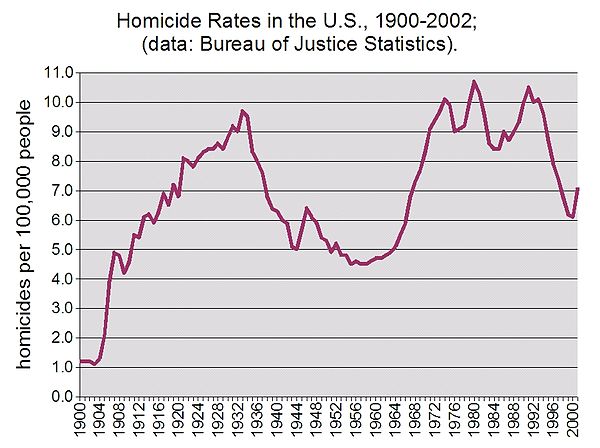
Of course, even during the breakdown, Iceland was still safer than the US at the peak of the crime wave:

According to a calculation by a scholar who went through the Sturlung sagas counting bodies, during more than fifty years of the violent breakdown of the traditional system the number of people killed or executed each year, on a per capita basis, was roughly equal to the rate of murder and non-negligent manslaughter in the United States in 1975.
600px-Homicide_rates1900-2001

Today, of course, Iceland is one of the world’s safest countries:

863px-Map_of_world_by_intentional_homicide_rate.svg
Murder rate per 100k people in 2012: light blue = 0-1; darkest blue > 20

That’s all for today; next week we’ll look at Somali law. Should be fun. Take care.

Why do people claim that whites “have no culture”?

A lot of culture–aside from that time your parents dragged you to the ballet–is what we would, in honest moments, classify as “stupid things people used to do/believe.”

Now, yes, I know, it’s a bit outre for an anthropologist to declare that large swathes of culture are “stupid,” but I could easily assemble a list of hundreds of stupid things, eg:

The Aztecs practiced human sacrifice because they believed that if they didn’t, the world would come to an end.

In Britain, people used to believe that you could literally eat the sins of a recently deceased person, speeding their entry into Heaven. There were professional sin eaters, the last of whom, Richard Munslow, died in 1906.

Americans started eating breakfast cereal as part of an anti-masturbation campaign, and in Africa, many girls have their clitorises cut off and vaginas sewn nearly shut in a much more vigorous anti-masturbation campaign.

The Etoro of Papua New Guinea believed that young boys between the ages of 7 and 17 must “ingest” the semen of older men daily in order to mature into men.

In Mozambique, there are people who kill bald men to get the gold they supposedly have inside their heads; in the DRC, there’s a belief that eating Pygmy people will give you magic powers.

People in Salem, Massachusetts, believed that teenage girls were a good source of information on which older women in the community were witches and needed to be hanged.

Flutes assume all sorts of strange roles in various Papuan and a few Brazilian cultures–only men are allowed to see, play, or listen to the flutes, and any women who violate the flute taboo are gang raped or executed. Additionally, “…the Keraki perform flute music when a boy has been sodomized and they fear he is pregnant. This summons spirits who will protect him from such humiliation.”

Spirit possession–the belief that a god or deity can take control of and speak/dance/act through a worshiper–is found in many traditions, including West African and Haitian Voodoo. If you read Things Fall Apart, then you remember the egwugwu, villagers dressed in masks who were believed to become the spirits of gods and ancestors. Things “fall apart” after a Christian convert “kills” one of the gods by unmasking him, leading other villagers to retaliate against the local Christian mission by burning it down.

In India, people traditionally murdered their moms by pushing them into their father’s funeral pyres (and those were the guys who didn’t go around randomly strangling people because a goddess told them to).

People in ancient [pretty much everywhere] believed that the gods and the deceased could receive offerings (burnt or otherwise,) of meat, chairs, clothes, games, slaves, etc. The sheer quantity of grave goods buried with the deceased sometimes overwhelmed the local economy, like in ancient Egypt.

Then there’s sympathetic magic, by which things with similar properties (say, yellow sap and yellow fever, or walnuts that look like brains and actual brains) are believed to have an effect on each other.

Madagascar has a problem with bubonic plague because of a local custom of digging up dead bodies and dancing around with them.

People all over the world–including our own culture–turn down perfectly good food because it violates some food taboo they hold.

All of these customs are either stupid or terrible ideas. Of course the dead do not really come back, Zeus does not receive your burnt offering, you can’t cure yellow fever by painting someone yellow and washing off the paint or by lying in a room full of snakes, and the evil eye isn’t real, despite the fact that progressives are convinced it is. A rabbit’s foot won’t make you lucky and neither will a 4-leaf clover, and your horoscope is meaningless twaddle.

Obviously NOT ALL culture is stupid. Most of the stuff people do is sensible, because if it weren’t, they’d die out. Good ideas have a habit of spreading, though, making them less unique to any particular culture.

Many of the bad ideas people formerly held have been discarded over the years as science and literacy have given people the ability to figure out whether a claim is true or not. Superstitions about using pendulums to tell if a baby is going to be a boy or a girl have been replaced with ultrasounds, which are far more reliable. Bleeding sick patients has been replaced with antibiotics and vaccinations; sacrifices to the gods to ensure good weather have been replaced with irrigation systems.

In effect, science and technology have replaced much of the stuff that used to count as “culture.” This is why I say “science is my culture.” This works for me, because I’m a nerd, but most people aren’t all that emotionally enthralled by science. They feel a void where all of the fun parts of culture have been replaced.

Yes, the fun parts.

I like that I’m no longer dependent on the whims of the rain gods to water my crops and prevent starvation, but this also means I don’t get together with all of my family and friends for the annual rain dance. It means no more sewing costumes and practicing steps; no more cooking a big meal for everyone to enjoy. Culture involves all of the stuff we invest with symbolic meaning about the course of our lives, from birth to coming of age to marriage, birth of our own children, to old age and death. It carries meaning for families, love, and friendship. And it gives us a framework for enjoyable activities, from a day of rest from our labors to the annual “give children candy” festival.

So when people say, “Whites have no culture,” they mean four things:

  1. A fish does not notice the water it swims in–whites have a culture, but don’t notice it because they are so accustomed to it
  2. Most of the stupid/wrong things whites used to do that we call “culture” have been replaced by science/technology
  3. That science/technology has spread to other cultures because it is useful, rendering white culture no longer unique
  4. Technology/science/literacy have rendered many of the fun or emotionally satisfying parts of ritual and culture obsolete.

Too often people denigrate the scientific way of doing things on the grounds that it isn’t “cultural.” This comes up when people say things like “Indigenous ways of knowing are equally valid as Western ways of knowing.” This is a fancy way of saying that “beliefs that are ineffective at predicting the weather, growing crops, curing diseases, etc, are just as correct as beliefs that are effective at doing these things,” or [not 1]=[1].

We shouldn’t denigrate doing things in ways that actually work; science must be respected as valid. We should, however, find new ways to give people an excuse to do the fun things that used to be tied up in cultural rituals.


Prison Law

51ta-us7crlKey tenants of the Prisoners’ Code:

  • Never rat on another convict
  • Don’t be nosy
  • Don’t gossip
  • Don’t lie
  • Don’t steal
  • Pay your debts
  • Don’t be weak
  • Don’t whine

Welcome back to our discussion of Legal Systems Very Different from Ours, by Friedman, Leeson, and Skarbek. Today we are discussing chapter 8: Prisoners’ Law–a subject of continuing interest to me, as you know.

While I have questioned why people would bother having multiple legal systems–why have parallel or multiple systems, instead of just one–what if we begin from the opposite assumption: why not have multiple legal systems? After all, modern societies are vast, with many different interest groups. There is the state, which wants mostly to promote trade, economic activities, and tax revenues–and will attempt to cut down on violent, predatory human (and animal) behavior to the extent that it interferes with the former. Then there are individuals, whose interests–like avoiding taxation and making sure their kids marry good spouses–are very different from the state’s.

If you have a state that is really trustworthy and definitely wouldn’t use knowledge of your assets gained during a divorce dispute to increase your taxes, then you might be happy to run your interests through the state-run legal system, but if you have any doubts about the state’s potential trustworthiness, you might want a different system to handle your more intimate problems.

Prisoners, of course, don’t have much hope of the state caring terribly much about resolving their disputes. I can’t imagine that prison guards really care that much if Prisoner A cheats Prisoner B out of cigarettes, so long as A and B both keep quiet and don’t make trouble. Even the murder of Prisoner A by Prisoner B may not trouble the guards, especially if it relieves them of some of their duties.

So prisoners–despite generally being lawbreakers themselves–have a strong incentive to create their own legal systems, and they do:

Nevertheless, across every period of prison life that we know about, we consistently find that officials provide only some… of the safety that prisoners crave. In fact, prisoners have developed a legal system of their own to order the society of captives.

… the nature of California prisons is that there are many resources that are held in common. The pull-up bars, tables and benches, handball courts, and basketball courts are freely open to all prisoners, at least officially. In reality, however, there is far more demand to use these resources than there is available supply.

The guards simply do not care enough to ration access to the facilities; prisoners work that out among themselves:

One prisoner associated with a Northern Hispanic gang explains, “If a new yard opens up, you’re going to fight for that handball court, you’re going to fight for some tables… If you ain’t a Northerner and you come into that areas, you’re going to get stabbed.”

a33cb02d3a31783ef86f3491039fbce6
Not getting harassed by antifa.

Gangs, like pirates and yellowjackets, wear their affiliations openly so you know not to mess with them. This, in turn, greatly reduces the chances of you getting stabbed.

Prisoners also have to set up their own systems of rules and enforcement because prisoners have a habit of doing illegal things, like selling drugs, and the government tends to look down on such activities and attempt to stop them (or at least take a cut of the profits). Prisoners can’t depend on prison guards to make sure they get paid for illegal drug deals, smuggled cigarettes, or hired violence.

For all these three reasons, in nearly any prison that scholars have studied, we find that prisoners create parallel, informal legal institutions.

The Prisoners’ Code–quoted at the beginning of the post–served California prisons prior to the 1960s. Adherence to the code meant that one was a “convict” in good standing with his fellows; those who violated the code were mere “inmates” in bad standing with their neighbors. Nobody likes a rat, and “inmates”, since they were regarded as having already violated the general trust, were fair game for victimization. Convicts, by contrast, had the general support of their fellows and so were protected.

The Code was fairly informal–not a written document, not formally agreed upon, not enforced by any particular body. It was just what everyone knew and agreed to, and who was and wasn’t a convict in good standing was just common knowledge.

Interesting, during this period, prisoners did not strictly segregate themselves by race and ethnicity. …

Edward Bunker, who served time in San Quentin prison in the 1950s and later, explained that, “although each race tended to congregate with their own, there was little overt racial tension or hostility. That would change in the decade ahead. what I did for a black friend in the mid-fifties is something I would never have even considered a decade later.”

Well damn. That sounds shitty.

1024px-PLISign
Point Lookout Cemetery, Angola Prison–final resting place of those who will never leave.

The Code broke down because the prison population exploded and became much more ethnically diverse during the great crime wave of the late 20th century. California prisons went from housing about 5,000 people total around 1950 to over 170,000 people in the 2000s. A system based on simply knowing whether or not the guy you were talking to was generally regarded as a convict in good standing breaks down when the system has 170,000 people in it.

This was compounded by the fact that the prison population was becoming much more ethically and racially diverse. Whereas in 1951 there used to be two white prisoners for every one black or Hispanic prisoner, that ratio had reversed by 1980. Heterogeneity undermines decentralized legal systems because it confounds consensus.

Or in other words, diversity leads to centralized authoritarianism.

Here’s a graph, for the visually inclined:

Inprisonment_Rates

Coinciding with these changes, there was a significant increase in prisoner on prisoner violence. … In response to this increasingly chaotic environment, prisoners turned to groups that today we often assume are the sources of disorder–prison gangs.

This makes sense–with too many inmates from too many backgrounds to enforce common norms via common knowledge, a new layer of organization–gangs–formed to fill the gap.

A formalist would say that we should make gangs official.

Gangs operate in a community responsibility system. Each prisoner must have an affiliation with a group, and each group is responsible for each members’ actions.

Sounds like Chinese law.

Of course, not everyone is a full member of a prison gang, just like not everyone is a paid member of the US government. Most prisoners, though, are affiliated to some group to some extent, following the rules set by their group.

Prison gangs often have written constitutions to order their internal workings. … There are clearly established leadership structures, and some of these positions are filled through democratic elections by a gangs’s members.

Sounds like pirates.

Prison gangs work to prevent conflicts between their members and resolve conflicts between their members and outsiders.

For example, if a member of one gang is delinquent in a drug debt to another group, that prisoner’s entire gang is responsible for it. He ma be forced to contact family on the outside to pay it off. The gang may pool their resources to pay it off. the gang may force the prisoner to work the debt off for the other gang… the gang itself might assault their own member to the extent that it satisfies the shot caller of the other group…

Gang-based governance outperforms the Prisoner Code because it requires less information about other people’s reputations. It is easier to know the reputation of a group than to know the reputation of every member of that group.

Seems like a lot of information processing works this way; I care less about the particular details of a random tree than “this is a tree.”

The authors argue that, even though gangs are usually blamed for crime, at least in the case of prisons, the rise of gangs coincided with a drop in crime:

… there was a nearly 90% decline in prisoner homicides from 1973 to 2012 (no data available from 1974-1979). During much of the 2000s, the homicide rate in prison was actually lower than outside of prisons. [!!!]

The homicide rate per hundred thousand prisoners was just over 60 (looks like 63 on the graph) in 1973, and bottomed out around 3 or 4 in 2001. There has been a slight increase in the most recent data, with about 8 murders per 100k in 2012.

Of course, prisons have probably taken measures to prevent inmates from killing each other, but I suspect that is difficult to convince people who are already in prison to be afraid of more prison, but it is easy to make them afraid of getting beaten.

But there are some ironies:

… despite a dramatic decline in the free world in racial prejudice since the 1940s, prison life is actually significantly more segregated today. Showers, telephones, handball courts, and even areas in the yard to sit are claimed by different racial groups and other races are not allowed to use them. Members of different races are not allowed to share cigarettes or meals together, or even live in the same prison cell.

Do the gangs prevent murder (if they do at all) by effectively threatening to make punishment painful for any would-be murderers, or by forcing people to segregate?

The authors note that organizing along racial lines solve information problems quickly–you can tell at a glance which group someone belongs to. But gangs have a variety of drawbacks as government systems–they tend to increase recidivism among their members, for example, and predatory behavior by senior gang members against lower-ranking members often goes unchecked because, being prisoners, they have nowhere else to go.

It is interesting that prison gangs are allowed to operate. Their primary purpose isn’t keeping peace and preventing murder (or so they claim), but doing business–selling drugs and the like. Peace is good for business; murder is bad for business because it gets the guards involved. One might think that prison guards would be uncomfortable with prisons being run by racial gangs that were formed to do illegal things, but either the guards don’t really care, it’s too hard to eliminate the gangs without a great deal more money and effort, or they’ve decided that life is just better with the gangs running things.

511Z26YT83L._SX322_BO1,204,203,200_That’s all for today, but please see some of my previous posts related to prisons: God of the Rodeo, about Angola Prison, Louisiana; and my review of Oriental Prisons: pt 1: Thugee; pt 2: Andaman Islands pt 3: Burma, China, and Japan; and pt 4: Egypt.

Next week, we’ll take a look at Saga-Era Iceland.

People who cannot find a place for themselves in society have nothing to lose if society burns

Detroit Abandoned Buildings
Detroit

I have I’m trying to write, but words aren’t flowing. Still, it’s a general fact: you preserve what’s yours; you love what’s yours.

When you don’t feel part of society, it stops mattering to you whether society burns. You know the principle: not my circus = not my monkeys.

Which means that you can’t half-ass community. Long term, you can’t have an underclass. You can’t have outcasts. You have to have community, and you can’t force it through some idiotic top-down “team building” exercise, because dammit, that will just make people hate each other even more. Community has to be a real thing that real people actually enjoy being part of, or they will, at best, let it fall apart; at worst they burn it down with you in it.

The Detroit riot of 1967 left 43 dead and 2,000 buildings destroyed; Detroit has yet to recover.

Xenophobia” is apparently the fancy new word people are using for old-fashioned racism in South Africa:

Prior to 1994, immigrants from elsewhere faced discrimination and even violence in South Africa. After majority rule in 1994, contrary to expectations, the incidence of xenophobia increased.[1] Between 2000 and March 2008, at least 67 people died in what were identified as xenophobic attacks. In May 2008, a series of attacks left 62 people dead; although 21 of those killed were South African citizens. The attacks were motivated by xenophobia.[2] In 2015, another nationwide spike in xenophobic attacks against immigrants in general prompted a number of foreign governments to begin repatriating their citizens.[3] A Pew Research poll conducted in 2018 showed that 62% of South Africans viewed immigrants as a burden on society by taking jobs and social benefits and that 61% of South Africans thought that immigrants were more responsible for crime than other groups.[4] Between 2010 and 2017 the immigrant community in South Africa increased from 2 million people to 4 million people.[4]

Why the hell did anyone think that majority rule by black people in South Africa would result in less racism? Is there something magical about voting that stops people from being racist? No, you idiots. (Not you, my gentle reader. I know you never thought such nonsense; you know that the media has reported on plenty of racist Americans voting in elections.)

According to a 2004 study published by the Southern African Migration Project (SAMP):

“The ANC government – in its attempts to overcome the divides of the past and build new forms of social cohesion … embarked on an aggressive and inclusive nation-building project. One unanticipated by-product of this project has been a growth in intolerance towards outsiders … Violence against foreign citizens and African refugees has become increasingly common and communities are divided by hostility and suspicion.[7]  “

What, being aggressively pro-your-own-group leads to being aggressively anti-other-groups? Who could have figured that one out?

Reminder that Johannesburg used to be a first world city.

Meanwhile, Nigerian TV has some interesting segments. “Shrine” seems to be a euphemism for “human sacrifice cult”:

Maybe some of those South Africans are on to something?

— Oh jeebus, I just read about lobotomies. Changing course, guys:

 Freeman’s name gained popularity despite the widespread criticism of his methods following a lobotomy on President John F. Kennedy’s sister Rosemary Kennedy, which left her with severe mental and physical disability.[2] … Walter Freeman charged just $25 for each procedure that he performed.[8] After four decades Freeman had personally performed as many as 4,000[11][12][13] lobotomy surgeries in 23 states, of which 2,500 used his ice-pick procedure,[14] despite the fact that he had no formal surgical training.[2] … Up to 40% of Freeman’s patients were gay individuals subjected to a lobotomy in an attempt to change their homosexual orientation, leaving most of these perfectly healthy individuals severely disabled for the rest of their life.[15]… His patients often had to be retaught how to eat and use the bathroom. Relapses were common, some never recovered, and about 15%[16] died from the procedure. In 1951, one patient at Iowa’s Cherokee Mental Health Institute died when Freeman suddenly stopped for a photo during the procedure, and the surgical instrument accidentally penetrated too far into the patient’s brain.[17] Freeman wore neither gloves nor a mask during these procedures.[17] He lobotomized 19 minors including a 4-year-old child.[18]

“We went through the top of the head, I think Rosemary was awake. She had a mild tranquilizer. I made a surgical incision in the brain through the skull. It was near the front. It was on both sides. We just made a small incision, no more than an inch.” The instrument Dr. Watts used looked like a butter knife. He swung it up and down to cut brain tissue. “We put an instrument inside”, he said. As Dr. Watts cut, Dr. Freeman asked Rosemary some questions. For example, he asked her to recite the Lord’s Prayer or sing “God Bless America” or count backward. “We made an estimate on how far to cut based on how she responded.” When Rosemary began to become incoherent, they stopped.[23]It quickly became apparent that the procedure had not been successful. Kennedy’s mental capacity diminished to that of a two-year-old child. She could not walk or speak intelligibly and was incontinent.[24]”

This guy won a nobel prize in medicine.

I don’t trust doctors very much.

A few other random thoughts:

I have no opinion on the Hong Kong protests because I am not from HK or China and don’t speak Chinese and so don’t know enough to have an opinion. I do think, however, that there is a frequent–and understandable–impulse crave excitement that modern life cannot otherwise supply. We want to be heroes; we want to be like the people in games and movies.

Even in Minecraft, a game that starts with you digging dirt blocks with your bare hands, ends with you fighting a dragon. People want that dragon; they want to be heroes, and who cares if it involves burning down someone else’s house? Characters in movies never stop to consider whether their rampages are flipping innocent people’s cars or preventing normal people from getting to their jobs; these mundane considerations pale to nothing when there is an ENEMY to be conquered… but often enough that enemy is just an invention of our own boredom.

Antifa, too, want to play-act being important by killing the enemy. It’s the same impulse that leads normal people to play video games; normal people are just good at distinguishing between games and real life.

Legally Pirate: Systems Very Different from Ours

Welcome back to our discussion of Legal Systems Very Different from Ours. Today we’re discussing chapter 7, Pirate Law.

Buccaneer of the Caribbean, from Howard Pyle’s Book of Pirates

We’ve already discussed Pirate Law a couple of times, based on articles by the same author, from the same source material, so some of this chapter is redundant if you’ve been reading this blog for a while, but it’s interesting enough to be worth a review.

The authors begin with an amusing comment on pirates’ odd popularity:

Only the Mafia approaches Caribbean pirates’ criminal celebrity, but large numbers of children do not dress up as mobsters to collect candy on Halloween.

On to business:

Successful piracy required the cooperation of a sizeable pirate crew. The average Caribbean pirate ship was crewed by 80 men, and the largest crews consisted of several hundred. This raises the question of how pirates, who, as criminals, could not rely on government to provide their crews law and order and had no compunction about murdering and stealing for private gain, manged to cooperate with one another to engage in piracy.

The fact that “even criminals” develop legal systems of some sort to regulate their relations with each other is one of the things I find fascinating about humans. Social organization springs up even in the most unlikely-seeming places, like prisons and criminal gangs, suggesting that order is a spontaneous and natural fact of human life (though the form that order takes varies).

Whatever order criminals form among themselves is also interesting because it is, by necessity, separate from the dominant legal systems; most criminals do not have the option of turning to the police should a fellow criminal stiff them on their share of the booty. (I suppose this has some parallels with the Chinese case, as the authors described it.)

1280px-Ships_Through_the_Ages_(4)
Ships through the ages: Pirate dhow; Spanish or Venetian galley; Spanish galleon The Dhow is a typical 16th century dhow, a grab-built, lateen-rigged vessel of Arabia, the Mediterranean, and the Indian Ocean. It has the usual long overhang forward, high poop deck and open waist. The dhow was notorious in the slave trade on the east coast of Africa, and even after a thousand years is still one of the swiftest of sailing crafts.

Pirates dealt with their problems by devising what is known as the “Pirate Code,” a set of laws that provided for the basically democratic conduct of the ship and division of the booty, with the captain in charge during battle. Since we already discussed these in previous posts, I will skip over the details, but you can read the book (or my previous posts on the subject), but suffice to say that pirates developed constitutions with voting, checks and balances, etc, that parallel democracy as developed in places like the US:

The institutional features of pirate law should sound familiar. They are more-or-less those of the American system of government: constitutional democracy, separated powers, and checks and balances. …

The most notable difference between pirate law and the American system of government is not their substance but when they were created and by whom. Pirate law was created by mostly illiterate, violent criminals in the early eighteenth century. The American system of government was created by the most educated and respected Europeans of their era more than half a century later.

The authors argue that pirate law must have been successful since piracy not only existed, but flourished, despite quite a bit of forceful opposition from European governments.

On pirate flags:

Most bandits do not announce their presence to their victims and potentially the authorities by publicly displaying a distinctive bandit logo

Proper placement of 1% motorcycle patch.

You sure about that, bud? Most criminal gangs I am familiar with, from the Mafia to street gangs to outlaw motorcycle clubs, advertise their status as criminals in rather obvious ways, like clothing patches, facial tattoos, or dapper Italian suits.

And it’s not just humans: wasps and bees, coral snakes and rattlesnakes, poison dart frogs and monarch butterflies, amanita muscaria and blue ringed octopuses  all signal “Stay away! I’m trouble!”

The natural principle is called “aposemetism,” which:

 refers to the appearance of an animal that warns predators it is toxic, distasteful, or dangerous. This warning signal is associated with the unprofitability of a prey item to potential predators. The unprofitability may consist of any defences which make the prey difficult to eat, such as toxicity, foul taste or smell, sharp spines, or aggressive nature. Aposematism always involves an advertising signal which may take the form of conspicuous animal colorationsoundsodours[2] or other perceivable characteristics. Aposematic signals are beneficial for both the predator and prey, since both avoid potential harm.

maxresdefault
Are bulborbs poisonous? Or do you just hallucinate if you eat one?

Of course, Pirates fly the Jolly Roger for the same reason: 

Pirates had a well-deserved reputation for mercilessness toward attackers [sic], which they earned by adhering t a simple policy: surrender or die. Pirates adopted this policy to minimize the cost of taking prizes. Violent confrontations with prey were expensive. … More peaceful piracy was therefore more profitable piracy secured, ironically enough, by pirates’ promise to slaughter resistors. …

To profit from this fact, pirates needed to ensure that their victims knew when they were being accosted by pirates… With few exceptions, only pirates flew the Jolly Roger, which is precisely why they did so.

And non-pirates who might like to dabble in the occasional ship-theft are unlikely to dilute the power of the Jolly Roger via mimicry due to the governments’ promise to execute anyone flying the Jolly Roger. This is kind of like if humans couldn’t tell the difference between coral and milk snakes, and so killed all of the milk snakes they could get their hands on: there would soon be pressure for milk snakes to not be orange.

Human criminal gangs make efforts to protect their symbols, to prevent dilution and ensure clear signalling power. The Hells Angels, for example have trademarked/copyrighted their symbols:

In March 2007 the Hells Angels filed suit against the Walt Disney Motion Pictures Group alleging that the film entitled Wild Hogs used both the name and distinctive logo of the Hells Angels Motorcycle Corporation without permission.[39] The suit was eventually voluntarily dismissed,[40] after the Angels received assurances from Disney that the references would not appear in the film.[41] …

In October 2010 the Hells Angels filed a lawsuit against Alexander McQueen for “misusing its trademark winged death heads symbol”[44] in several items from its Autumn/Winter 2010 collection. The lawsuit is also aimed at Saks Fifth Avenue and Zappos.com, which stock the jacquard box dress and knuckle duster ring that bear the symbol, which has been used since at least 1948 and is protected by the U.S. Patent and Trademark Office. A handbag and scarf was also named in lawsuit.[45] The lawyer representing Hells Angels claimed: “This isn’t just about money, it’s about membership. If you’ve got one of these rings on, a member might get really upset that you’re an impostor.”[46] … The company settled the case with the Hells Angels after agreeing to remove all of the merchandise featuring the logo from sale on their website, stores and concessions and recalling any of the goods that have already been sold and destroying them.[48][49][50]   

In fall 2012 in the United States District Court for the Eastern District of California, Hells Angels sued Toys “R” Us for trademark infringementunfair competition, and dilution in relation to the sale of yo-yos manufactured by Yomega Corporation, a co-defendant, which allegedly bear the “Death Head” logo.

Clear signals work better than unclear signals, example # 6,700,789.

That’s all for now; see you next week.


Apidima Sapiens?

Two fossil skulls from Apidima, Greece, tell an intriguing story. The first, more than 210,000 years old, appears to be an early Homo sapiens. The second, a younger 170,000 years old, looks like a Neanderthal.

If so, then Homo sapiens moved to Greece, were replaced by Neanderthals, then thousands of years later moved back and replaced the Neanderthals (“replaced” is generally a polite word for “killed.”)

This is consistent with a fair amount of other evidence that Homo sapiens had (at least) two out-of-Africa events, of which the one that killed the Neanderthals was only the most recent. It could also represent the population wave that interbred with Neanderthals, contributing Sapiens DNA to the Neanderthal genome, well before the more famous interbreeding event when Neanderthal DNA entered our modern Homo sapiens genome.

On the other hand, there’s not a whole lot to these fossils. One is just the back of a skull. The back of a skull is more informative than it sounds on first glance because neanderthals have a bump (referred to as a “bun”) on the backs of their skulls that we don’t, but still, we’re not talking about complete skulls. So it could turn out that this was just a funny looking Neanderthal, or a piece that got pressed weirdly by a rock (the first Neanderthal skeleton people found had arthritis, which threw all of the illustrations off for decades, so these things can happen).

But throwing caution to the wind, let’s assume the skulls are correct, and so is the rough timeline I sketched out: Neanderthals inhabit Europe, Sapiens leave Africa, Sapiens push into the Middle East and Greece, Sapiens fail, Neanderthals retake the region, years pass, Sapiens try again and this time succeed, wiping out the Neanderthals.

What changed? What made the first attempt a failure and the second successful?

Aside from Sapiens generally getting smarter, I suggest a humble invention: the sewing needle.

We know from studies of lice (ew, I know) that humans began wearing clothes around 80-170,000 years ago. How do we know? Because the lice that live on our heads and the lice that infect our clothes are different species, and genetics claims that’s when they split.

The earliest known “looks like a needle” comes from Sibudu Cave, South Africa, and dates from about 61,000 years ago, but needles are small and easily broken, so I suspect that plenty were used that we haven’t found.

Neanderthals did not wear clothes–quoting Wikipedia, quoting archaeologist John F. Hoffecker:[102]

Neanderthal sites show no evidence of tools for making tailored clothing. There are only hide scrapers, which might have been used to make blankets or ponchos. This is in contrast to Upper Paleolithic (modern human) sites, which have an abundance of eyed bone needles and bone awls. Moreover, microwear analysis of Neanderthal hide scrapers shows that they were used only for the initial phases of hide preparation, and not for the more advanced phases of clothing production.

— John F. Hoffecker, The Spread of Modern Humans in Europe

Bodyhair_map_according_to_American_Journal_of_Physical_Anthropology_and_other_sourcesIf the Neanderthals did not have clothes, then they had to adapt to the European climate in other ways–probably fur.

(Incidentally, according to the only data I have on the matter, Mediterranean and Nordic peoples are oddly hairy, while Siberian people are weirdly not-hairy. If anyone has any idea why this is I’d love to hear it.)

If the first wave of Sapiens to leave Africa also did not have clothes (or had only very rudimentary clothes) and they lacked the Neanderthals’ fur, then they would have had a very difficult time surviving in the harsh European winters.

Like the Roanoke colony, the survivors may have happily gone over to the Neanderthal side.

By the time the second wave of Sapiens showed up, however, they had invented clothes–and had other elements of a more advanced cultural/technological toolkit that let them conquer the elements–and the ‘Thals.

Our AI future

edmond-de-belamy-framed-cropped
AI generated art

The First AI-Generated Piece of Art Comes to Auction:

AI artwork sells for $432,500 — nearly 45 times its high estimate — as Christie’s becomes the first auction house to offer a work of art created by an algorithm

I honestly think that within ten years or so, a large percent of the “media” people consume, from TV to porn to news to music to art, will be computer-generated and only vaguely checked/edited by humans for errors.

We’re already halfway there. The news content in your feed is already curated by computer algorithms. Your YouTube playlists and recommendations are curated by algorithms.

Walmart uses Big Data, not human logic, to determine that Poptarts should be stocked next to the hurricane supplies. Walmart never had to think, “People want tasty food that doesn’t require cooking in waterproof packaging when hurricanes are coming” to notice a trend in the data and stick the poptarts next to the bottled water.

But those are algorithms dealing with human-produced inputs; some human did actually invent the poptart.

AI generated story (the bold text was my input):

The dark elf walked into an inn, carrying a harp and dagger.  He approached the bed when a rous’do shouted, “Oh, that’s my archer! I got you!”  “Hah! I told you to leave me alone.”  Dark elf pulled out a weapon he found lying on the bed, pointing it at the hooded man, “Oh, I thought that you wouldn’t be so clever. I’ll take your archer with me!  So please, don’t come back!”
Dark elf shouted, “I ain’t leaving you alone!  Don’t come back, you filthy, rotten little whore!”  “I ain’t leaving you alone!  No, this time I’m taking all you have and turning you into a fine specimen!”  “I ain’t leaving you alone.”
The hooded man yelled, “Oh, my God!”  “Don’t you know we have enough to eat?  Come to my house, we’re on the list to have your head on a plate!  I will have you punished!”
“No no!  I can’t.  It’s not fair.”  “I said you can’t!”  “Oh, really?  That’s a great idea!

Some AI generated news:

Donald Trump proposed buying Greenland today.  I wonder if we could do to ourselves what he did to Scotland, to Greenland. Trump’s promise to build a barrier around Greenland would be a major change in tone, considering his attitude toward North Korea as well.
We were reminded recently that it has been three decades since the last time a major American leader came to Greenland to visit.  I can recall only one visit–and it was a very short visit.  I imagine the President’s visit could be as small or as large as he wants, without much of a change in tone.  So maybe we could do it too.
What did George W. Bush do for the people of Greenland?  Well, we probably got our oil, but no oil.  There’s just enough room for one of his family’s homes–but the rest of the land is off limits.  Trump has not been shy in his praise of Greenland’s icecaps, saying: When I see it there, you see the majesty of the icecaps…. When I look and see how Greenland has been working since this summer, people are thanking me for all this ice…. I know Greenland well.  From Greenland is a country where you have to learn about your country.  Ice is also a key economic component for Greenland.

AI generated porn, coming soon:

These technologies aren’t great yet, but they’re improving fast. And besides, how do you know your memes weren’t AI-generated already?

3cvyu3szyid21
What does this thing even mean?

In some areas, like art, the AI will be vastly better than us humans. Cameras already are; algorithms trained on the likes of Kinkaid, Wyland, Rembrandt, and Monet will churn out cheap, beautiful art (and calendars) in any style you want.

In other arenas, like novels and news articles, the results will be bad, mostly because so much nuance goes into human language, politics, and communication. People will consume these anyway.

Once the main use of AI-generated art isn’t avant-garde but beautiful, people will argue that it isn’t “real art” and only plebes will buy beautiful AI-generated paintings, while AI-generated news will seep into your feed without you even noticing. Entire classes will consume AI-gen news without blinking an eye.

In a way, they already are.

AI-generated porn has the potential to be good, but in practice will be terrible because no one cares if their porn is terrible.

Eventually, whether one consumes media made by actual humans will become a social marker of sorts–probably first of low status, as only rich people can afford $400,000 paintings; later of high status, as AI-generated memes and incoherent news articles flood the timelines of people who are, unfortunately, not smart enough to realize that they don’t make sense.

tay-says-you-are-dumb-too
Burned by the machine

Of course, AI will not be neutral. Remember the time Microsoft released an AI chatbot and let it just interact with the internet, but forgot that the internet is full of humans and humans love teaching parrots to curse, so they had to shut it down?

When you think about it, humans are really the weak link in AI-generated content.

The Amish, of course, will just go on about their lives, interacting with real humans while the rest of us watch AI-generated superhero mashups with a never-ending AI-news ticker in the bottom right hand corner of our VR dome, probably while sipping bug-protein based soylent replacement because people were afraid soymilk would give them boobs.

The video games will be awesome, though.

Islamic Law

1024px-samarkand2c_registan2c_ulugbek_medressa_28623856502029
Photo of the lovely Samarkand Ulugbek Madrassa by Arian Zwegers

Welcome back to Legal Systems Very Different from Ours. Today we’ll be discussing Islamic law; with any luck, someone who actually knows something on the subject will drop by and weigh in.

Strictly speaking, what traditional Islamic courts enforced was not Shari’a, God’s Law, but fiqh, jurisprudence, the imperfect human attempt to deduce from religious sources what human law ought to be. That fact helps explain how Sunni Islam was able to maintain four different but mutually orthodox schools of law. There could be only one correct answer to what God wanted humans to do but there could be more than one reasonable guess.

This sounds like a bit of technicality that I am skeptical of people observing in practice, so I went over to Pew.

The World’s Muslims: Beliefs about Sharia: 

gsi2-chp1-2

According to the survey findings, most Muslims believe sharia is the revealed word of God rather than a body of law developed by men based on the word of God. Muslims also tend to believe sharia has only one, true understanding, but this opinion is far from universal; in some countries, substantial minorities of Muslims believe sharia should be open to multiple interpretations. …

Although many Muslims around the world say sharia should be the law of the land in their country, the survey reveals divergent opinions about the precise application of Islamic law.

Pew doesn’t distinguish between “sharia” and “fiqh”

In 17 of the 23 countries where the question was asked, at least half of Muslims say sharia is the revealed word of God. (For more information on sharia see text box.) In no country are Muslims significantly more likely to say sharia was developed by men than to say it is the revealed word of God. …

gsi2-chp1-3In 17 out of 21 countries, “there is only one interpretation of sharia” beat “there are multiple interpretations.”

Support for making sharia the official law of the land varies significantly across the six major regions included in the study. In countries across South Asia, Southeast Asia, sub-Saharan Africa and the Middle East-North Africa region most favor making sharia their country’s official legal code. By contrast, only a minority of Muslims across Central Asia as well as Southern and Eastern Europe want sharia to be the official law of the land.

In South Asia, high percentages in all the countries surveyed support making sharia the official law, including nearly universal support among Muslims in Afghanistan (99%). More than eight-in-ten Muslims in Pakistan (84%) and Bangladesh (82%) also hold this view. The percentage of Muslims who say they favor making Islamic law the official law in their country is nearly as high across the Southeast Asian countries surveyed (86% in Malaysia, 77% in Thailand and 72% in Indonesia).

In sub-Saharan Africa, at least half of Muslims in most countries surveyed say they favor making sharia the official law of the land, including more than seven-in-ten in Niger (86%), Djibouti (82%), the Democratic Republic of the Congo (74%) and Nigeria (71%).

Support for sharia as the official law of the land also is widespread among Muslims in the Middle East-North Africa region – especially in Iraq (91%) and the Palestinian territories (89%). Only in Lebanon does opinion lean in the opposite direction: 29% of Lebanese Muslims favor making sharia the law of the land, while 66% oppose it.

So I have a little skepticism of the authors’ claim that Muslims normally distinguish between Sharia and Fiqh and that they’re totally okay with multiple, co-existing interpretations of the law.

More likely, the average Muslim believes multiple, vaguely contradictory things about Sharia that are basically piety signals, because most Muslims are just trying to live their lives and feed their families, not legal scholars.

“Should we run the country according to God’s laws?” the pollster asks, and the faithful reasonably respond that “Yes, of course we should run things according to God’s laws.”

“Does God’s law come from God or from man?” the pollster asks, and the faithful responds, “From God, obviously. It’s in the name.”

With those caveats, let’s get back to Legal Systems Very Different from Ours. The authors then explain the five-fold division of acts in Islamic law, which I have converted to a rough table:

Obligatory act:         God rewards for performing,      Punishes for not performing
Recommended act: God rewards for performing,      No punishment for not performing
Permissible act:       No reward for performing,          No punishment for not performing
Offensive act:          No punishment for performing,   Reward for abstaining
Unlawful act:           Punishment for performing,         Reward for avoiding

… Islamic law is more nearly a system of morality than a system of law, since its rules primarily describe how one ought to act, only secondarily the legal consequences of action. …

How was fiqh deduced and applied? The scholar started with the sources of revealed knowledge–the Koran itself and the words and acts of Mohammad and his companions as reported in hadith, traditions. From that information a sufficiently learned religious scholar, a mujtahid, deduced legal rules. Over time, the scholars separated into four schools… The schools were generally similar but differed in the details of their approaches to interpretation and the rules they deduced; each regarded the others as orthodox.

Any Muslim readers want to weigh in on how accurate this is?

Anyway, Islamic law then developed over the years the same problems of any legal system: bloat, excessive writing, technological and cultural change, and multiple conflicting interpretations, all of which could make it difficult to determine what the “original” idea of the law had been.

It was necessary to decide for each hadith how certain one could be that it was neither invented by someone at some point down the purported chain [of legal descent] nor inaccurate due to an error in transmission.

The basic rule accepted by all schools was that if there were a sufficient number of independent chains supporting the same hadith, it could be accepted as genuine with certainty.

Muslims inventing the blockchain.

It followed that if at any one time all of the scholars were agreed upon a question, that question was permanently settled.

Law and the State:

After first few centuries and until the rise of the Ottomans, political authority in the Islamic world was fragmented. The local rulers were frequently foreigners to the populations they ruled… What they wanted from the legal scholars was support for their legitimacy. … they were willing for the most part to leave the legal system in the hands of the scholars. … Think of the resulting system as what Anglo-American common law would be if law professors ran the world, law defined not by the precedents set by judges but by the medieval equivalent of law review articles.

So… does it work? How well does it work? In the chapter on Icelandic law, the authors are willing to actually interrogate why Icelandic law broke down (in the Middle Ages) and what made it initially effective and then ineffective. There’s a little discussion in the chapter on Chinese law on how people managed to conduct business effectively despite (or because) of the lack of relevant formal legal rules. But in general the authors shy away from asking how effective the legal systems actually are, which seems like a critical piece of information. If a system works well and the people in it are pleased with the results, then it seems reasonable to see if it is a system with parts that can be felicitously copied, borrowed, or implemented; if a system works badly, (as many do) then it is wise to examine what makes it dysfunctional and try to avoid those components in our own system.

Of course, the functioning of many legal systems probably does come down, as Confucian scholars might say, to the ethics/wisdom inherent in the people in them.

But anyway:

From the perspective of modern American law, the final two stages of the process look like our system turned upside down. In ours,t he court of first impression applies the law to the facts and produces a verdict. If the case is appealed, the appeals court takes the facts as already decided and gives a second and authoritative opinion on the law In their system, the opinion on the law came first, provided by the mufti, followed by the qadi’s application of the law to the facts as he saw them. Under most circumstances there was no way to appeal the qadi’s verdict.

madhhab_map3
Prominent schools of Islamic law (aka madhhab) by region

The authors note that they have described the “traditional account” of how Islamic law developed; some modern scholars claim this is all kind of retconned from existing Arabic law and modified over time as new provinces were conquered. I’m sure this is also to some extent true, as whatever laws people were already using on matters like marriage and murder probably persisted post-conversion.

Anyway, so there are multiple “schools” of Islamic legal thought:

While the schools differed in detail they regarded each other as mutually orthodox. In this respect as in others, the history of Islamic law both resembles and differs from that of Jewish Law. The schools of Hillel and Shammai tolerated each other for several generations, but eventually the majority school suppressed the minority. In the parallel Islamic case, the four schools of Sunni law have continued their mutual toleration up to the present day. …

The four schools of law are all Sunni; the Shia have their own schools and legal rules… While different schools were dominant in different areas, a medieval Muslim city could have had separate courts for the four Sunni schols, the Shia, and the other tolerated religions. It was a polylegal system; disputes within each community would go to that community’s courts. Non-Muslims had to use Muslim courts for criminal cases but had choice of law for civil matters. … What happened in a dispute between parties adhering to different legal systems is not entirely clear…

I wonder how this worked in practice.

While law was in theory independent of the of the state, in practice, in most historical Islamic societies, state-created rules played a significant role. … One reason for the development of parallel state curts may have been the desire of the ruler to maintain control A second was that fiqh had serious limits as a legal system. …

The authors then look at the “breakdown” of the Islamic legal system.

The breakdown of the traditional legal system may, as Hallaq argues, be due to the rise of the nation state, but the connection between that and western imperialism is accident not essence. The causes that led to the rise of the nation state in the west, the replacement of feudalism by absolute monarchy, operated in the Islamic world as well… The annexation of the waqfs by the Ottoman authorities parallels the earlier confiscation of the lands of the monasteries by Henry VIII. The result in both cases was to eliminate institutions that competed with the sate for power and resources. 

This is the kind of theory I like.

Then there is a section with more details on the actual content of the legal code, eg:

The part of fiqh that applies to homicide or bodily injury is called jinyat and appears to be based on the pre-Islamic rules of Arab blood feud.

Blood feuds are interesting and I think there is a chapter later on that looks at feud systems in more detail. But I wonder how these systems translate over geography–that is, across the Islamic world, from Morocco to Indonesia. Did the spread of Islam result in these areas adopting laws that were originally Arabian, or did each region effectively retain its own existing legal system? And how is it all working out today?

Wikipedia has an interesting bit: 

The transformations of Islamic legal institutions in the modern era have had profound implications for the madhhab system.[65] Legal practice in most of the Muslim world has come to be controlled by government policy and state law, so that the influence of the madhhabs beyond personal ritual practice depends on the status accorded to them within the national legal system.[65] State law codification commonly utilized the methods of takhayyur (selection of rulings without restriction to a particular madhhab) and talfiq (combining parts of different rulings on the same question).[65] Legal professionals trained in modern law schools have largely replaced traditional ulema as interpreters of the resulting laws.[65] Global Islamic movements have at times drawn on different madhhabs and at other times placed greater focus on the scriptural sources rather than classical jurisprudence.[65] The Hanbali school, with its particularly strict adherence to the Quran and hadith, has inspired conservative currents of direct scriptural interpretation by the Salafi and Wahhabi movements.[65]Other currents, such as networks of Indonesian ulema and Islamic scholars residing in Muslim-minority countries, have advanced liberal interpretations of Islamic law without focusing on traditions of a particular madhhab.[65]

Old China, New China

I think people have generally been underestimating china. When I was young, China wasn’t doing so well–I mentally classed it alongside India, which is also a mega-country of over a billion people living in similar levels of poverty–but in the past few decades, China has surged ahead.

Yes, China uses tech in ways that sound like dystopian nightmares. Yes, there’s something going on with Uyghirs and camps. Yes, pollution. But it is impossible to deny that the average Chinese citizen has become massively more prosperous and that China is bubbling with innovative energy.

I recently heard a speech–I think it was given by Obama several years ago about Shanghai’s test scores being higher than American ones–claiming that this was our “Sputnik moment.”

No.

It’s not.

Going to the moon is something a command economy can do, even a command economy with capitalist characteristics. The government can allocate a few billion dollars, hire a bunch of rocket scientists, and tell them to go to the moon.

Generalized innovation, energy, and economic growth are not things you can command, which is why the Soviet Union was always stagnant on the ground. America cannot outclass China unless the energy for doing so comes from the people themselves.

But enough about America.

Here’s the zoom on a Huawei phone camera:

You must excuse me if I think the recent buzz about Huawei being evil is due to tech companies like Apple realizing that Huawei is about to eat their lunch with cheaper, better tech.

If you think China isn’t going to eat our lunch, don’t argue with me, just go out there and succeed.

More Laws, Please: Jewish Law is Different from Ours

51ta-us7crlWelcome back to our discussion of Friedman, Leeson, and Skarbek’s Legal Systems Very Different from Ours. Today we’ll be discussing Jewish law.

Jewish law may be the best-recorded legal system in the history of the world; there are hundreds of thousands, perhaps millions, of pages of surviving primary sources covering about twenty-five hundred years.

I think I’ve mentioned before that I had this idea once back in college to do a project on parallel legal systems like Gypsy law, and thankfully someone talked me into switching to Jewish law, mostly out of concern for my physical safety.

But Jewish law is also massively better documented.

One thing I find amusing about Jewish law is that Jews seem to actually like the subject. I can’t tell if that’s something people feel like they’re supposed to say in the same way that people feel like they should claim to like school even if they actually hated it, but they certainly give the impression of being rather enthusiastic on the subject. Where the traditional practice of Chinese law can be summarized as “Please go away and leave us alone,” or “good people don’t need law,” the Jewish approach seems like “More laws, please.”

Problems of Divine Law

Jewish law was, in theory, based on a single unchangeable source–the Torah [first five books of the Bible.]… Basing the law in this way rather than on custom, precedent or legislation raised two problems shared with other legal systems similarly based, including Fiqh (Islamic Jurisprudence) and American Constitutional Law.

Note: I wrote a post about this: The Talmud and the Constitution. The trouble comes in when two scholars/judges/etc disagree about what exactly the law should be:

In a system that views law as the creation of a legislature, king, or court of last resort, the same authority that made the law can settle disagreements about it. That does not work for a legal system viewed not as created but as discovered, deduced from divinely inspired sources.

Obviously you need some way to resolve disputes about what exactly the laws should be; you also need some way to change laws should new circumstances arise that necessitate doing so.

The initial solution to the problem of legal uniformity was a simple one. Truth is not determined by majority vote but law can be. … the legal scholars took the position that the interpretation to be followed by judges was determined by the views of the majority of legal scholars.

There follows an amusing story about some rabbis who were arguing about whether an oven could be cleaned. The majority of rabbis held one opinion; the dissenting rabbi’s opinion was closer to the original religious text. God steps in on the dissenting rabbi’s side, at which point the other rabbis basically tell Him to back off, this is a rabbi matter.

His position was summed up by another Rabbi as “The Torah has already been given at Mount Sinai. We pay not attention to a heavenly voice because You have already written in the Torah at Mount Sinai, ‘Follow the Majority.'”

According to the story, God smiled and said to himself, “My children have bested me.”

Most people I have discussed this story with object to it. They just can’t fathom the idea of telling God to buzz off and let the humans interpret divine law. Yet, as a parent, there have certainly been times when my children, as God put it, bested me. And in those moments I didn’t feel irritated or angry, but proud of them for their growth and maturity.

Anyway, as for the Jews, the authors make a good point that you’re much more likely in normal life to encounter cranks and grifters claiming divine revelations than you are to encounter actual divine revelations, so it’s a good idea to just reject divine revelations.

There is an interesting parallel between the conflict between the two schools of Jewish law, ending in the victory of one of them, and the development of Muslim law almost a thousand years later. In the early centuries of Islam, Sunni legal scholars divided themselves into four schools of law named after, and to some degree based on the teaching of, four of the early legal scholars. The schools differed in details of legal interpretation but regarded each other as mutually orthodox–and still do. …

One solution to the problem of [Jewish] legal diversity was the development of geographical schools Judges in France mostly went by the legal opinion of whoever was currently the most prominent legal scholar among French Jews…

This makes sense, given the difficulties of disseminating legal opinions to a diasporic population spread thinly across thousands of miles before the invention of cheap printing and fast transportation.

One of the other difficulties with Jewish law is that after 2,500 or so years, so much has been written that the whole mass has gotten terribly unwieldy:

Once the Talmud was complete, legal scholarship was built on top of three layers. The first was the Torah. That was followed by rabbinic legislation and commentary and interpretation based on the Torah, culminating in the Mishnah. That was followed by commentary on the Mishnah, culminating in the Talmud. Scholarship thereafter consisted largely of commentary on the Talmud, which had the previous two layers embedded in it, along with additional legislation. Further layers were added as one or another work based on those sources–the Mishneh Torah of Maimonides is one example–itself became the subject of further commentary.

This has generally been resolved via books summarizing previous decisions accompanied by more detailed legal books if one needs them, and the development of the previously mentioned local or communal law. Of course, sometimes this led to conflicts between different levels of interpretation or commentary.

There follows an interesting discussion of how marriage customs and especially the laws around marriage could have been modified to increase parental control over whom their children marry, but it is too long to quote here–you will have to read the chapter yourself.

A theory on kosher rules:

Careful observance of such rules is evidence that the observer believes in the religion, since he is willing to bear substantial costs in order to conform to its requirements. The fact that he believe sin the religion means that he will be reluctant to sear, falsely, for fear of supernatural punishment.

Well, maybe. It’d be nice to have some data on the matter.

Maimonides [a famous Jewish legal scholar] goes on to describe in some detail the rules associated with the avenger of blood,t he heir of a killer’s victim, and the cities of refuge–of which, like kings of Israel, there had been none for more than a thousand years. A killer was supposed to go to one of the cities of refuge, be brought from there to the court of the city where the killing occurred, tried and, if guilty of deliberate murder, put to death by the avenger of blood. If found guilty of unintentional killing he was to be sent back to the city of refuge to remain there until the high priest, also nonexistent in Maimonides’ day, died. En route to or from the city of refuge he could be killed by the avenger of blood without penalty.

That looks rather like the remnant of a pre-existing feud system, untidily integrated into its replacement.

It’s late and I’m pretty tired, so let’s wrap things up. I’m sorry I don’t have more to say, but I’ve already hit the point of exhaustion and I said a lot on the subject back in Why Does my Fridge Have a Sabbath Mode? and The Talmud and the Constitution.